Structural Drying Services Near Me
Starting price: Call for pricing
Structural drying is the science of getting a soaked building back to safe moisture levels before mold or rot can set in. Capital Restoration Services sets up commercial LGR dehumidifiers and air movers in a layout matched to your home's materials, then takes daily moisture readings until every wall, floor, and cavity tests dry. If you're dealing with the aftermath of a flood, burst pipe, or storm leak, call (877) 276-1067 and we'll get equipment running fast.
What structural drying really means
A wet building doesn't dry on its own — not really. Airing out a soaked room might make it feel dry in a few days, but the wood framing behind the wall and the pad under the carpet are still holding water. Mold doesn't care what the surface feels like. It starts in the hidden spots, sometimes within a day or two of the leak.
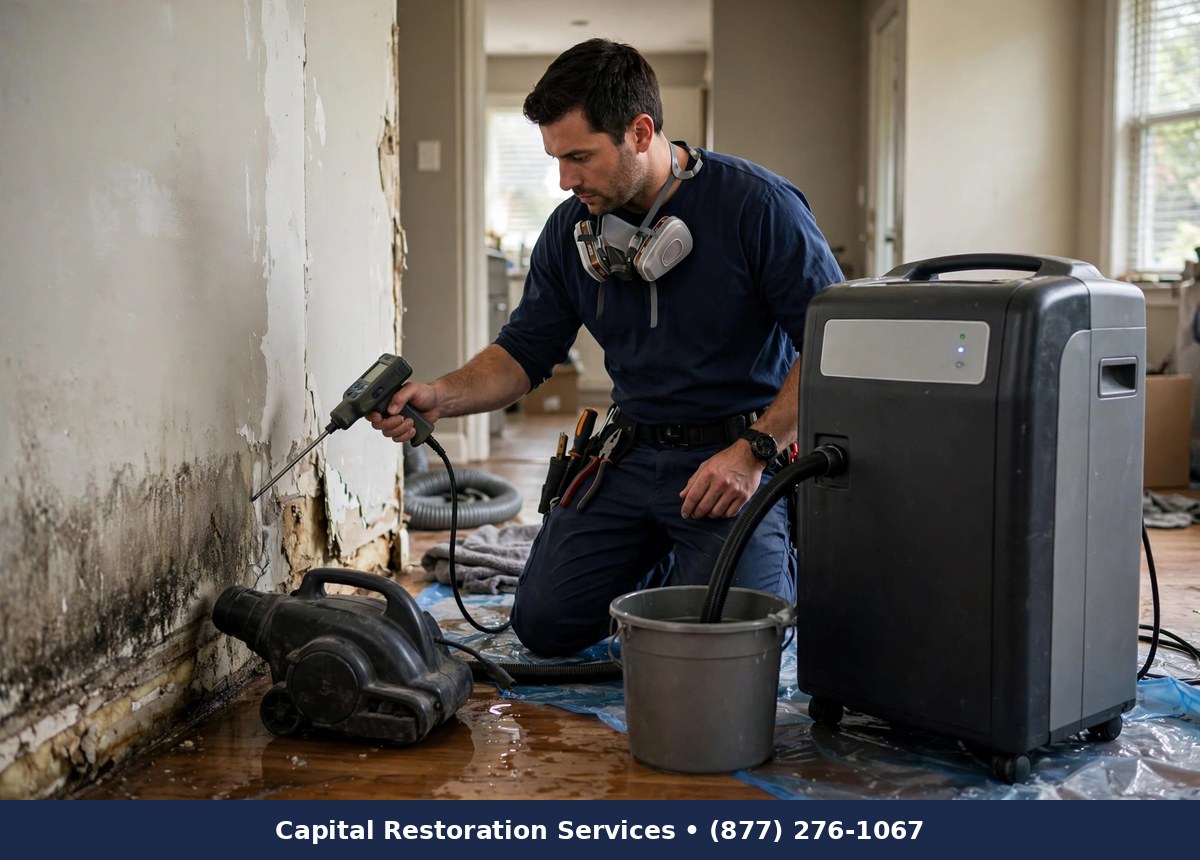
Structural drying is the professional answer to that problem. Instead of waiting, we put engineered equipment in the space that pulls moisture out of the materials themselves — the studs, the subfloor, the bottom course of drywall — not just out of the air. A fan from the garage and a small store-bought dehumidifier can't do this work. We use low-grain refrigerant (LGR) dehumidifiers that keep wringing water out of the air even when the air is already fairly dry, paired with air movers that push a fast sheet of air right across wet surfaces. The two work as a team: the movers lift moisture off the surfaces through evaporation, and the dehumidifiers catch it before it can settle somewhere else. Run only one of the two and drying stalls — movers alone just push wet air around, and dehumidifiers alone can't reach moisture trapped against the wall.
Signs your building needs professional drying
- Drywall that's soft, swollen, or bubbling near the floor
- Baseboards pulling away from the wall or starting to warp
- Hardwood planks cupping at the edges
- Paint or wallpaper blistering off the wall
- A musty smell that appeared after the leak
- Carpet that squishes underfoot or smells sour
- A room that still feels damp days after the water was cleaned up
How our drying process works
First, we find every wet spot — not just the obvious ones. Infrared cameras show us temperature differences where water is hiding, and pinless meters scan whole walls in seconds. Pin-type meters then give us exact readings at marked spots, and those numbers become our baseline.
Next, any standing water gets extracted. Drying equipment can't beat standing water, so pumps and extractors clear it first. Then the drying setup goes in. Air movers are angled so air flows across — not straight at — wet walls and floors, and dehumidifiers are sized to the room and the amount of water. This placement isn't guesswork. It follows the industry drying standard (IICRC S500), which treats drying as controlled science: the right balance of air movement, humidity, and temperature.
Some materials can't be dried and have to go. Soaked carpet padding, insulation that holds water like a sponge, and drywall that's sagging or crumbling get removed before drying starts. Trying to dry them wastes days and feeds mold.
Then comes the part some companies skip: we come back and measure. Every day, we take readings at the same spots and log them, so you can see the moisture curve dropping toward the dry standard — the reading we'd get from an unaffected area of the same material. When every spot hits that standard, the equipment comes out and you get the log.
What affects the cost
Nobody can quote a drying job without seeing it, and here's why. The biggest driver is how much space got wet and how long the water sat. A supply line that ran for an hour is a different job from a leak that hid behind a wall for a month. The materials matter too: tile over concrete dries far faster than hardwood over a crawlspace, and dense materials like plaster need more time than drywall. If water got into wall cavities, we may need to open walls so air can reach the framing, which adds labor. The water's contamination level changes the protocol as well — a clean supply-line break is straightforward, while a sewer backup needs sanitizing steps before drying can begin. Emergency calls at odd hours also run differently than scheduled work. Call (877) 276-1067 and describe what happened, and we'll give you a straight answer about what the job involves.
What you can do while the equipment runs
Drying equipment is loud and needs to keep running around the clock — switching it off for quiet hours sets the whole process back. Keep the room closed up so the dehumidifiers aren't trying to dry the whole neighborhood's air. Don't move the equipment; the angles were set on purpose. If something sounds wrong or a unit starts blowing hot air, call us instead of unplugging it. And stay out of rooms with removed drywall or exposed cavities until we say they're clear. Most jobs run a few days, so a little patience now saves weeks of repair later.
How Capital Restoration Services serves homes and businesses across the area
We dry single-family homes, rentals, condos, and small commercial spaces — anywhere water got into the structure. Our trucks carry the full drying setup, so a small apartment leak and a whole-office flood both get proper equipment, not a couple of box fans. When you call (877) 276-1067, a real person takes the details and dispatches a crew that can start moisture mapping on the same visit. The goal is always the same: your building truly dry, documented, and ready for repair without a mold problem waiting to surface.
Features
- LGR and desiccant dehumidifiers sized to the space and the water load
- High-velocity air movers placed for true airflow across wet surfaces
- Pin and pinless moisture meters plus infrared cameras to map wet zones
- Daily moisture logs that show real, measurable drying progress
- Wall-cavity and under-floor drying that reaches hidden pockets of water
- Hardwood floor drying mats that can save cupped planks in place
Benefits
- Mold never gets its foothold when materials dry within days
- Hardwood, drywall, and cabinets can often stay instead of being torn out
- Documented readings back up your insurance claim
- Less demolition means repairs wrap up sooner
- Drying to the true dry standard, not just dry to the touch
- One crew handles the full job from water removal through final readings
Frequently asked questions
How long does structural drying take?
Most residential jobs run three to five days with equipment in place, but the real answer depends on how wet things got and what they're made of. Wood framing and subfloors dry on a different schedule than drywall. We measure daily and pull equipment when readings hit the dry standard — not before.
Can hardwood floors be dried in place, or do they always need replacing?
Often they can stay. We use floor drying mats that pull moisture out of cupped planks, and many floors flatten back down as they dry. If the wood is badly warped or was wet for weeks, replacement may be the honest answer. We check before deciding either way.
Do we have to move out while you dry the building?
Usually not. The equipment is loud and the space stays warm, so it's not the most comfortable few days, but most families stay put. If contaminated water is involved or large areas of wall are open, we may recommend keeping certain rooms off-limits.
How do you know it's really dry and not just dry on the surface?
We don't trust our hands for this. Meters read moisture inside the material, and we compare every wet spot to a dry reference area of the same material. Equipment comes out only when the numbers match.
Will my homeowner's insurance cover structural drying?
Often yes, especially when the damage came from a sudden event like a burst pipe. Our daily moisture logs and photos give your adjuster the documentation insurers want. We can't promise what your policy covers, so check with your agent early.
How much does structural drying cost?
It depends on the size of the wet area, the materials involved, whether walls must be opened for cavity drying, and how long the water sat. A quick call to (877) 276-1067 with the details gets you a real answer, not a guess.