Structural Fire Damage Repair Near Me
Starting price: Call for pricing
After a fire, the part you can't see often matters more than the part you can. Capital Restoration Services inspects fire-damaged framing, determines what still has strength and what must be replaced, then repairs or rebuilds the structure to current code. From board-up through final rebuild, one crew handles it. Call (877) 276-1067 for a full structural assessment.
What structural fire damage repair actually covers
Fire damage to a house is three problems stacked on top of each other. There's the burned part — charred studs, scorched sheathing, a roof section that's seen too much heat. There's the smoke part — acidic soot driven into every porous surface, which keeps corroding and smelling until it's truly removed. And there's the water part — hundreds of gallons from firefighting that soaked into whatever the fire didn't burn.
Structural repair deals with the first problem head-on and handles the other two as part of the same job. We evaluate which members of the skeleton are still sound, remove what's compromised, and rebuild what's missing to code. What it doesn't cover on its own: restoring your furniture and belongings (that's a separate contents process), and purely cosmetic smoke cleanup of rooms the fire never touched structurally. Those are real services, but they're different scopes with different crews.
When a fire means repair, not just cleaning
Not every fire needs structural work. A small kitchen flare-up that never got past the cabinets is usually a cleaning job. Structural repair enters the picture when the fire reached the bones of the house. Warning signs:
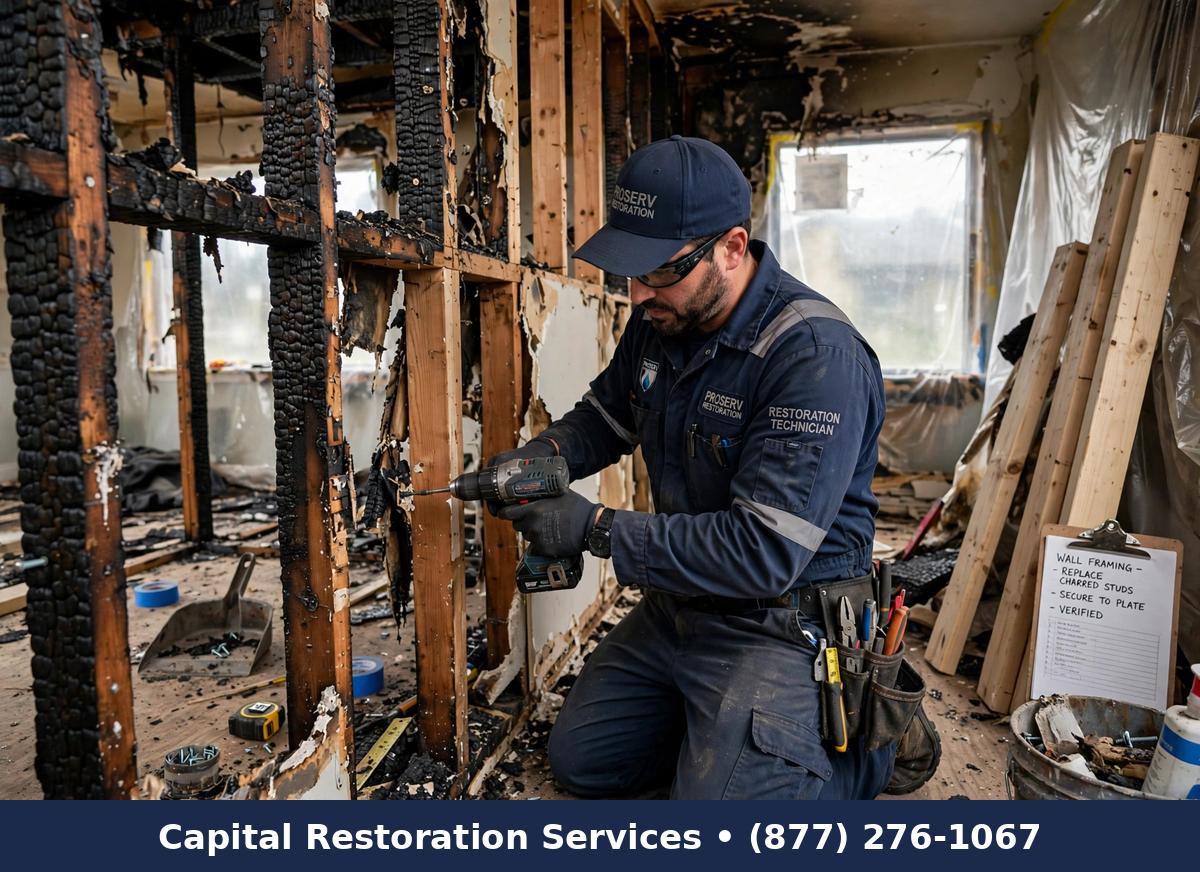
- Charring on studs, joists, or roof rafters
- Drywall that's cracked, buckled, or falling off in sheets
- A sagging ceiling or roofline after the fire
- Doors and windows that suddenly won't close — the frame shifted
- Exposed wiring, melted plumbing, or a compromised chimney
- Soot staining that goes deeper than surface wipe-downs can reach
If the fire department ventilated the roof by cutting into it, that's structural work by definition — someone has to rebuild that opening properly. And if flames got into the attic, expect framing damage even in rooms that look untouched from below. Heat rises, and attics are where fire does its quietest structural damage.
How our repair process works
Everything starts with assessment. We walk the structure with a critical eye: which members are surface-charred but solid underneath, which are cracked through, which lost cross-section to the point they can't carry their load. Char depth matters more than how black something looks — a stud can look terrible and still test strong, or look fine and be compromised. Where the damage is severe, a licensed structural engineer's evaluation may be needed, and we coordinate that.
Next comes securing the property. Open walls, missing windows, and cut roofs get boarded up and covered so weather and trespassers don't add a second disaster. Then the unsalvageable comes out: framing that's lost strength, ruined drywall, soaked insulation, melted mechanicals. Salvageable wood gets cleaned, often by media blasting with baking soda or dry ice, which strips char and soot without chewing up the wood. After blasting, surfaces are treated to neutralize the acidic residue soot leaves behind. This step matters more than most people realize: soot mixed with moisture turns acidic and keeps eating into materials and metal fasteners long after the fire is out.
Then we rebuild. Damaged members are replaced, connections are brought up to current code, and the structure is dried out from firefighting water before anything gets closed up — closing wet framing inside a wall is how post-fire mold starts. Finally, the clean framing gets an odor-sealing treatment before insulation and drywall go in. Paint and finishes go over a sealed, deodorized structure, so the smoke smell doesn't come back the first humid summer.
What affects the cost
The range here is wider than almost any other restoration work, because the question is never "how much does fire repair cost" but "how much of the house burned." A single-room fire with light charring is a different universe from a whole-house loss. The framing type matters — simple platform framing is more straightforward than post-and-beam or truss systems. How long the structure sat open to weather after the fire matters too, since rain on exposed framing adds water damage to the scope. Code upgrades are another factor: rebuilding often has to meet current codes, which can mean better wiring, sprinklers, or seismic ties that weren't in the original house. And the smoke side of the job — odor sealing, HVAC cleaning, contents — scales with how far the smoke traveled, not just where the flames were. The honest way to get a number is a full assessment and a line-item scope. Call (877) 276-1067 and we'll walk you through what yours actually involves.
What happens if structural fire damage goes unrepaired
It doesn't stay the same — it gets worse. Charred framing keeps off-gassing odor, and every humid spell reactivates the smell. Acidic soot residue keeps working on metal connectors, nails, and plates. Weakened members settle under load, and settling shows up as cracked drywall, sticking doors, and eventually roof problems. Insurers also take a dim view of unrepaired fire damage; it complicates claims and future coverage. The house may look "fine enough" for a while, but the damage is load-bearing, not cosmetic, and load-bearing problems don't heal.
How Capital Restoration Services works with homeowners across the area
We handle fire jobs from the first board-up through the final walkthrough, so you're not juggling a mitigation company, a demolition crew, and a separate contractor. We photograph and document everything as we go, and our scope is written the way adjusters expect — line by line, no mystery items. Whether it's a single room or a whole house, call (877) 276-1067. We'll assess the structure, tell you plainly what it needs, and carry the job through to a house you can actually live in again.
Features
- Structural assessment of framing, roof members, and load-bearing walls
- Char and soot removal on salvageable wood via media blasting
- Demolition and replacement of framing that lost strength in the fire
- Re-framing built to current building codes, not old shortcuts
- Odor-sealing of exposed framing before new finishes go up
- Drying of fire-suppression water so the structure doesn't grow mold later
Benefits
- A clear verdict on what must be replaced and what can safely stay
- No trapped smoke odor under your new drywall and paint
- Repairs that meet today's code, protecting your home's value
- One team from assessment through the final coat of paint
- Photo documentation and line-item scope your adjuster can work with
- A house that's genuinely safe to live in, not just repaired to look fine
Frequently asked questions
Can charred wood be saved, or does it all have to be replaced?
It depends on how deep the char goes. Light surface char on a member that's still strong underneath can be media-blasted clean, neutralized, and sealed. Wood that's cracked through, lost significant cross-section, or crumbles under pressure has to be replaced. We test rather than guess.
How long does structural fire repair take?
A single-room repair can wrap up in weeks; a whole-house rebuild takes months. The timeline follows the damage: assessment, demolition, cleaning, re-framing, and finishing each take their turn. We give you a realistic schedule after the assessment, not before.
Will the smoke smell come back after repairs?
Not if the work is done right. The smell returns when odor gets sealed under new finishes instead of being removed first. We blast and neutralize framing, then apply an odor-sealing treatment before insulation and drywall go in, so there's nothing left to off-gas.
Should I go inside the house after a fire?
Wait for official clearance first. Fire-damaged structures can have weakened floors and roofs, and soot is genuinely irritating to breathe. We'll board up and secure the property, and we can retrieve essential items with proper precautions.
Do you work with insurance adjusters?
Yes. We document with photos at every stage and write the scope line by line in the format adjusters expect. That keeps the claim moving and avoids the back-and-forth that delays so many fire jobs.
What does structural fire damage repair cost?
It tracks the extent of the damage more than anything else — how many members need replacing, how far smoke traveled, and what code upgrades the rebuild requires. A full assessment is the only honest way to price it. Call (877) 276-1067 and we'll scope yours properly.