Subfloor Water Damage Repair Near Me
Starting price: Call for pricing
Your floor covering is only as good as what's underneath it. When water reaches the subfloor, plywood swells and separates and OSB loses strength — and new flooring over a wet subfloor just traps the problem. Capital Restoration Services locates the damage with moisture meters, dries what can be saved, replaces what can't, and leaves you with a flat, solid base. Walking on a floor that doesn't feel right? Call (877) 276-1067.
The layer under your feet does all the real work
You never look at your subfloor, but everything you own stands on it. That sheet of plywood or OSB between your floor covering and the joists carries every footstep, every piece of furniture, and every appliance in the room. It's also the layer water reaches first and leaves last. Spills, slow appliance leaks, and floodwater all work their way down through flooring — even so-called waterproof flooring — and pool on top of the subfloor or soak straight into it.
Plywood and OSB react differently to that soaking. Plywood tends to swell at the edges and, with enough water, its layers start to separate — delamination. OSB swells too, and the swelling releases the compaction stress from manufacturing, which leaves the panel weaker and less able to hold fasteners. Either way, the result is a subfloor that no longer does its job quietly: it flexes, it creaks, and it gives new flooring nothing solid to sit on.
How to tell your subfloor has water damage
The subfloor hides under your flooring, so you read the symptoms through what's on top:
- Spongy or bouncy spots when you walk across the room
- Flooring that's buckling, tenting, or pulling apart at the seams
- Tile grout cracking in a pattern that follows the subfloor panels
- A musty or earthy smell that gets stronger near the floor
- Dark staining visible around floor vents or at the edges of the room
- Baseboards warping or pulling away at the bottom
- A floor that feels uneven underfoot where it used to feel flat
Any of these is worth a professional check before you cover it with new flooring.
Dry it in place or cut it out?
This is the central judgment call of every subfloor job, and it's where experience matters. A panel that's merely wet — no swelling, no separation, still flat and solid — can often be dried in place with dehumidifiers and directed airflow, monitored with meters until it reaches the dry standard. The finished flooring above usually has to come up first so moisture can escape, but the subfloor itself can stay.
A panel that's swollen, delaminated, or soft to the probe can't be dried back to strength. OSB that has lost its internal density and plywood with layers coming apart will never be what it was, no matter how dry they get. Those panels get cut out to the nearest joists, the joists get inspected and dried, and new panels go in with proper fastening and a small expansion gap at the edges. ## How our subfloor repair process works
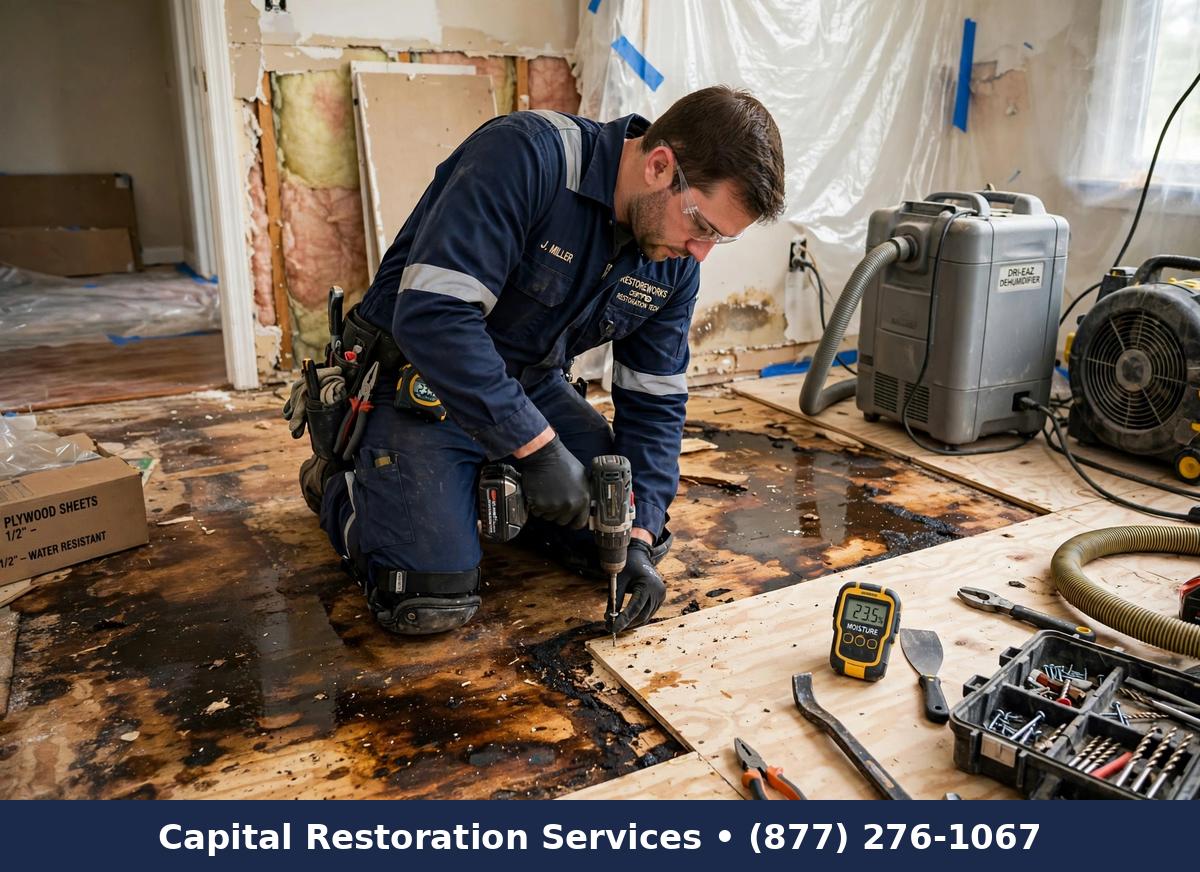
We start by finding the full extent of the wet area — not just where the flooring looks bad. Pin meters test the subfloor's actual moisture content, and infrared cameras pick up wet zones that haven't shown symptoms yet. Then the finished flooring comes up over the affected area, which lets us see the subfloor directly and gives it air to dry.
Next, the source of the water gets confirmed as stopped. Repairing a subfloor while a leak is still feeding it is pointless, so we make sure the plumbing, appliance, or exterior issue is resolved before we rebuild. Then each panel gets its verdict: dry in place or cut out. Drying panels get dehumidifiers and air movers with daily meter readings. Cut-out panels get removed to the joists, the joists get checked for rot and treated if needed, and new panels are cut, gapped, and fastened.
Before we call it done, the whole repaired area is verified dry and flat. Your flooring installer gets a solid, level base — or, if we're handling the finished floor too, we move straight into that work without a gap in the schedule.
What affects the cost
Size is the obvious driver — a bathroom subfloor is a different job than an open-plan living area — but access shapes the price just as much. A ground-floor room with a crawlspace below is straightforward to inspect and dry; a second-floor subfloor with a finished ceiling underneath is harder to reach and monitor. The panel verdict matters too: drying in place costs less than cutting out and replacing, and the ratio of the two decides the labor. If joists are rotted, the job grows. And the finished flooring you choose afterward affects the total — tile needs a flatter, stiffer base than carpet does. Call (877) 276-1067 and describe what your floor is doing; we'll tell you what the repair actually involves.
How Capital Restoration Services handles flooring jobs across the area
Subfloor work sits between water mitigation and flooring installation, and it often gets skipped by both. Mitigation crews dry the room; flooring installers lay the new floor; nobody checks what's in between. We do. Whether it's a dishwasher leak that softened one bathroom panel or a flood that reached half the first floor, we find the damage, fix the subfloor properly, and document the moisture readings so the new floor above has nothing to hide. Call (877) 276-1067 — and walk your floors with confidence again.
Features
- Pin-probe moisture testing of plywood and OSB subfloors
- Infrared scanning to find wet areas the eye can't see
- Targeted drying of subfloor sections that can still be saved
- Clean cut-out and replacement of delaminated or rotted panels
- Joist and beam inspection under every repaired section
- Proper panel fastening and gap spacing on every replacement
Benefits
- New flooring goes over a truly dry base — no trapped moisture
- Spongy, bouncing spots in the floor disappear
- Mold can't keep growing in a subfloor that's dried or removed
- Your floor stays flat so tile doesn't crack and wood doesn't buckle
- We catch weakened joists before they become a bigger repair
- One crew handles the subfloor so your flooring installer can just install
Frequently asked questions
Can a wet subfloor dry on its own, or does it always need work?
A lightly wet panel can dry with help — dehumidifiers, airflow, and the finished flooring removed so moisture can escape. A swollen or delaminated panel won't recover its strength no matter how dry it gets, and it needs to be replaced. The meter readings and a hands-on check tell us which one you're dealing with.
How do I know if the damage is in the subfloor and not just the flooring?
Spongy or bouncing spots, buckling that follows panel seams, and musty smells near the floor all point underneath. The sure way is to lift a vent cover or a corner of the flooring and look: staining, swollen edges, or soft material on the subfloor itself confirm it. We test with pin meters so there's no guessing.
Do you replace the finished flooring too?
We remove the affected finished flooring to reach the subfloor, and we can handle the new flooring as part of the same job if you'd like. Some customers prefer their own flooring installer — either way, we leave a dry, flat, documented base ready for them.
What happens if I just put new flooring over a wet subfloor?
The moisture gets trapped and keeps working. Expect buckling, mold growth under the new floor, musty smells that won't quit, and eventually having to tear the new flooring back up to fix what should have been fixed first. It's one of the most expensive shortcuts in home repair.
How long does subfloor repair take?
A small section that's dried in place can be done in days; larger cut-and-replace jobs take longer, mostly because of drying time between steps. We don't rush the drying — a floor that's closed up wet is a floor that fails.
What does subfloor water damage repair cost?
It depends on the square footage, whether panels can be dried or must be replaced, how accessible the area is, and whether joists need attention too. A quick description to (877) 276-1067 gets you a realistic picture of your specific job.