Textile and Upholstery Smoke Cleaning Near Me
Starting price: Call for pricing
Fabric drinks in smoke. Couches, drapes, mattresses, and clothing trap soot deep in their fibers, and one wrong cleaning move — like washing before dry soil removal — can set the stain permanently. Capital Restoration Services treats smoke-damaged textiles and upholstery with the right sequence: dry soil removal first, then targeted wet or dry cleaning, then real deodorization. Call (877) 276-1067 before the damage sets.
Why smoke loves your fabrics
Smoke is lazy — it settles where the air is stillest, and that's inside your couch cushions, your drapes, your mattress, and your closet. Fabric fibers are rough at a microscopic level, which gives soot particles endless places to lodge. Worse, the oily part of soot bonds with fibers over time, and the longer it sits, the harder it becomes to release. A shirt left in a smoky closet for a month is a fundamentally harder job than the same shirt cleaned the week of the fire.
This is also why textiles are the canary in the coal mine after a fire. If your clothes still smell like smoke after airing out, the upholstery in that room needs professional attention too — it's holding the same residues, just with more material for them to hide in.
The order of operations matters more than the products
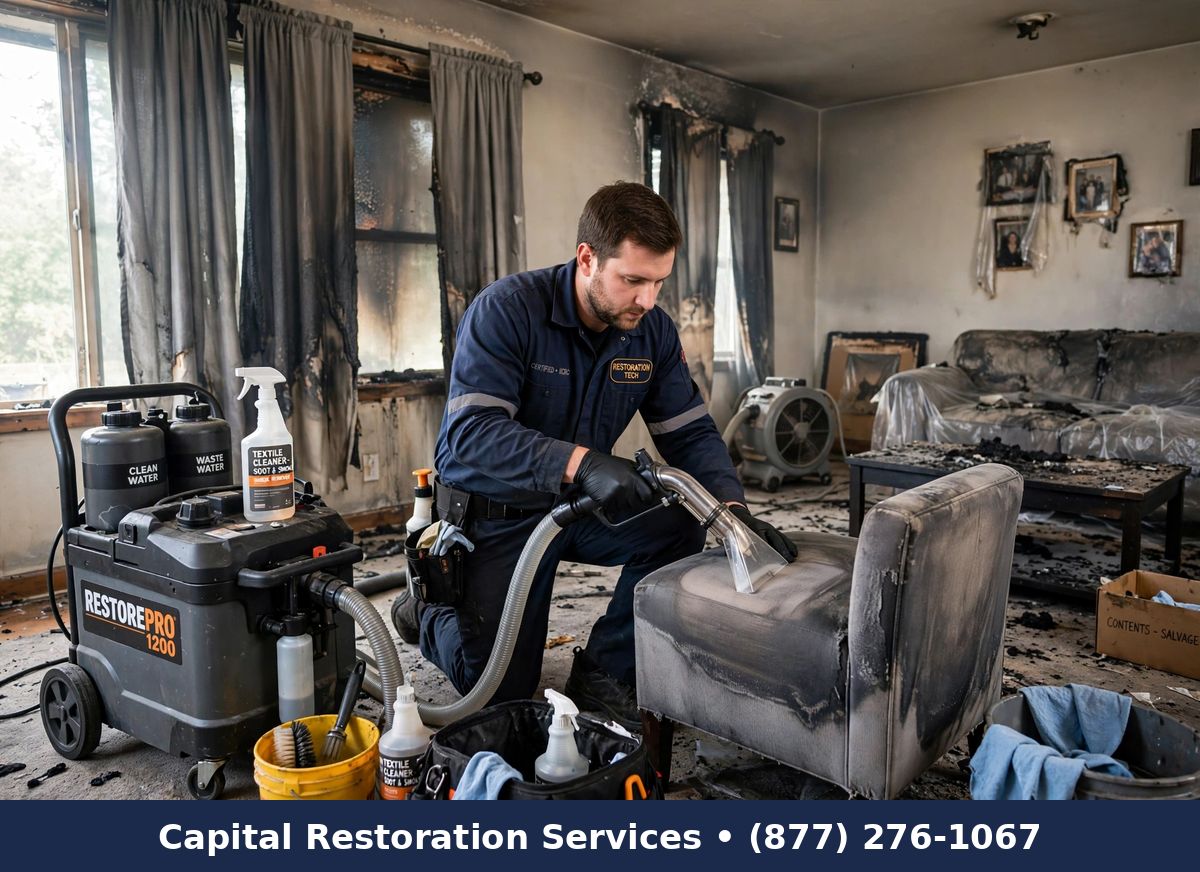
Here's the mistake that ruins more smoke-damaged fabric than anything else: wetting it before the dry soot is removed. Water turns loose soot into a slurry that drives deeper into fibers and can set as a permanent stain. The correct sequence starts completely dry. We lift loose soot with HEPA-filtered vacuums — held slightly above the surface, never pressed in — and work dry-cleaning sponges over the fabric to pull up what the vacuum leaves. Only when the dry soil is out do we decide on wet methods.
That decision depends on the fabric. Washable textiles may go through specialized laundry systems with deodorizing additives. Dry-clean-only pieces get solvent-based cleaning, sometimes through two separate solvent baths so contaminants aren't redeposited. Upholstered furniture often needs hot-water extraction with the right chemistry for the fiber type. Delicate items — silk drapes, antique upholstery, wedding dresses — may go through ultrasonic cleaning, where microscopic bubbles do the work without harsh agitation. There's no single right method; matching the method to the material is the whole skill.
What deodorization actually means
Cleaning removes the soot you can see. Deodorization removes the smell you can't — the odor molecules trapped inside fibers and foam. Surface sprays and scented products just cover it up, and the smell comes back with humidity. Real deodorization breaks odor molecules apart. For textiles, that usually means time in an ozone or hydroxyl chamber after cleaning, where oxidizing gases penetrate the fibers and neutralize the compounds causing the smell. Foam cushions, which hold odor like a sponge holds water, often need the longest chamber time. When an item comes out of deodorization properly, it smells like nothing — and nothing is exactly what you want.
What can and can't be saved
Honesty matters here, because not everything survives a fire's smoke. Most clothing, bedding, drapes, and upholstered furniture in good condition before the fire can be restored if we get to them reasonably soon. Mattresses are borderline — the deep foam layers are hard to fully deodorize, and we give you a straight answer rather than a hopeful one. Items with heavy protein-fire soot (from a kitchen fire) are tougher than items from a wood-and-paper fire, because protein residues bond aggressively and discolor. Anything already fragile — sun-rotted drapes, foam crumbling with age — may not survive the cleaning process itself, and we'll tell you before we try. Every item gets a save-or-replace verdict, and the ones that can't be saved are documented for your contents claim.
How the pack-out process works
For most fire jobs, we don't clean your textiles in your living room. We pack them out: every item is inventoried, photographed, and tagged, then moved to our cleaning facility while your home undergoes structural restoration. This keeps your belongings out of the construction zone — where dust and demo would re-soil them — and lets the cleaning happen with the right equipment. Cleaned and deodorized items go into secure storage until your home is ready, then come back in a coordinated return. You get the inventory list, so nothing vanishes into the process.
What affects the cost
Quantity and condition drive this more than anything — a closet of clothes is a different job than a whole house of upholstered furniture and drapes. The soot type matters: light dry soot cleans faster than heavy oily or protein residues. Delicate items that need ultrasonic or hand work cost more per piece than standard laundry processing. How long the smoke sat before cleaning started matters too, since set-in residues take more passes. And pack-out, storage time, and return logistics add to the total on larger jobs. What doesn't change: we'll tell you upfront which items are worth the cleaning cost and which should go on the replacement list instead. Call (877) 276-1067 and let's look at what you've got.
How Capital Restoration Services treats your belongings across the area
Your things aren't line items to us — they're the reason the house matters. We handle textile and upholstery smoke cleaning for homes and businesses across the area, from a single smoke-damaged recliner to a full-house pack-out after a major fire. Every item inventoried, every method matched to the material, every verdict honest. Call (877) 276-1067 — and let's see what we can bring back.
Features
- Dry soil removal with HEPA vacuums and dry-cleaning sponges before any wet cleaning
- Ultrasonic cleaning for delicate and heavily soiled textiles
- Fabric-specific cleaning: solvent-based for dry-clean-only, extraction for washable
- Ozone and hydroxyl deodorization chambers for deep-set smoke odor
- Pack-out, inventory, and secure storage while your home is being restored
- Honest save-or-replace verdicts on every item, documented for insurance
Benefits
- Heirlooms and favorite pieces get a real chance at coming back
- The right cleaning sequence means stains don't get locked in
- Smoke odor is neutralized at the molecular level, not masked
- Your belongings are cleaned off-site while your home gets repaired
- Itemized inventory makes the insurance contents claim straightforward
- You don't gamble your grandmother's chair on a DIY experiment
Frequently asked questions
Can the smoke smell really be removed from fabric, or is it permanent?
It can genuinely be removed in most cases. Cleaning takes out the soot, and then ozone or hydroxyl deodorization breaks down the odor molecules trapped in the fibers. What doesn't work is masking it with scented sprays — that just postpones the smell until the next humid day.
Should I wash smoke-damaged clothes myself?
Not before the dry soot is removed. Washing first can drive soot deeper and set stains permanently. If you must handle items before we arrive, shake them out gently outdoors and don't rub the fabric. Then let us do the dry soil removal before any wet cleaning.
Can you save a smoke-damaged mattress?
Sometimes, but mattresses are the hardest textile to fully deodorize because the odor gets deep into the foam layers. We'll assess yours honestly — if the cost of cleaning approaches replacement and the odor is deep, we'll tell you to claim it instead of cleaning it.
How long does textile smoke cleaning take?
A few pieces can be turned around in days. A full-house pack-out with cleaning, deodorization, and storage runs alongside your home's structural restoration — often weeks. We coordinate the return so your belongings come back to a finished home, not a construction zone.
Do you clean on-site or take items away?
Both, depending on the job. Small jobs can be handled in your home. Larger jobs get a full pack-out: inventoried, photographed, cleaned at our facility, stored securely, and returned when your home is ready. Off-site cleaning also keeps items away from ongoing demolition dust.
What does textile and upholstery smoke cleaning cost?
It depends on how many items, the type of soot, how delicate the fabrics are, and whether pack-out and storage are involved. We'll assess your items and give you a clear picture — including which pieces are worth cleaning and which belong on the replacement list. Call (877) 276-1067.