Thermal Fogging Deodorization Near Me
Starting price: Call for pricing
Smoke got into places no sponge can reach — inside wall cavities, behind outlet covers, deep in porous wood. Thermal fogging fights back the same way the smoke got in: as a fine fog that travels the same paths and neutralizes odor molecules where they hide. Capital Restoration Services uses it as the finishing step after real cleaning, not as a shortcut around it. Still smelling the fire weeks later? Call (877) 276-1067.
The idea behind thermal fogging
Smoke is a gas carrying microscopic particles, and that's exactly why it's so hard to get rid of. It flowed into every crack, pore, and cavity in your home — behind switch plates, into wall voids, through the grain of unfinished wood. No amount of wiping reaches those places, because a cloth can't go where air went.
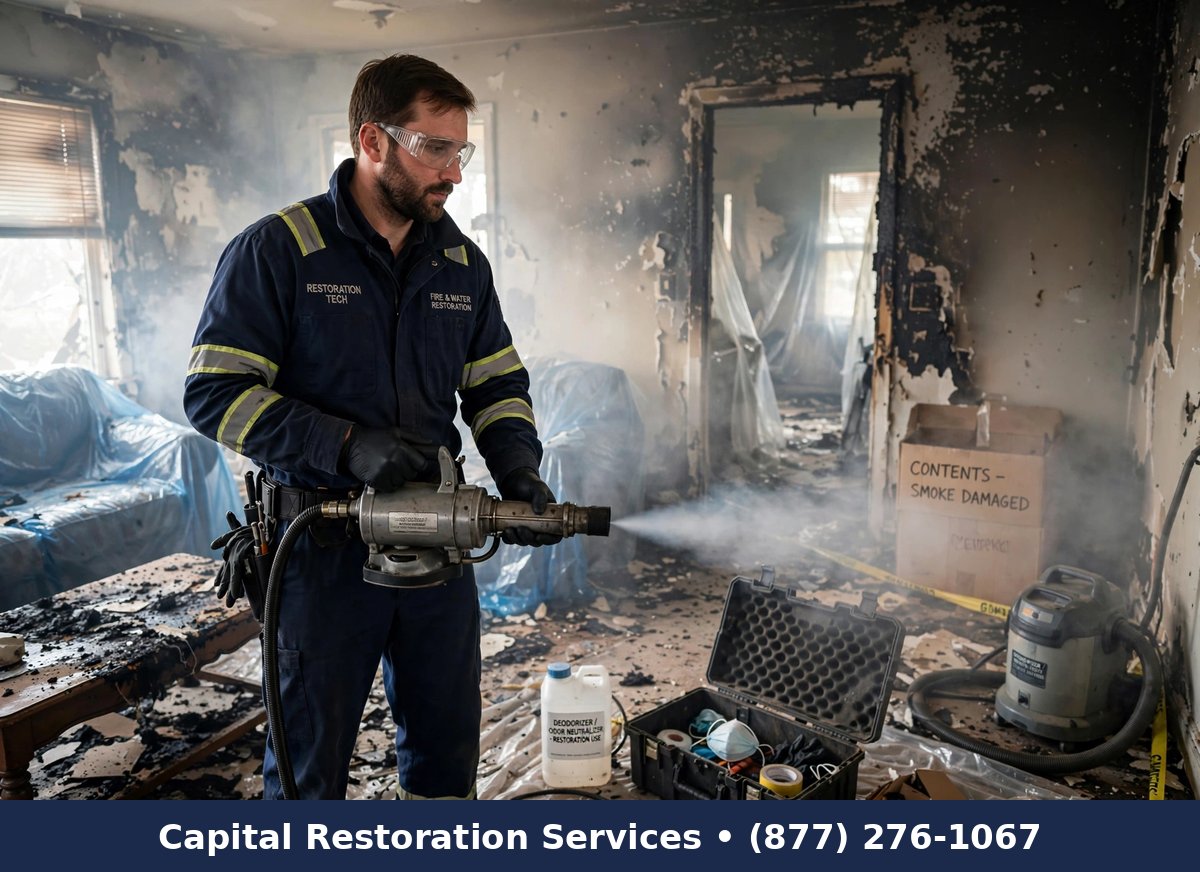
Thermal fogging answers with the same physics. A thermal fogger heats a deodorizing solution until it becomes a fine, dry fog — particles so small they behave like the smoke did, drifting into the same cracks and pores. Where the fog meets odor-causing residues, the chemistry neutralizes them instead of masking them. It's the closest thing to fighting fire with fire that the restoration industry has, except nothing burns — the heat is in the machine, not in your home.
Fogging is the finish, not the whole job
Here's what separates professional deodorization from a spray-and-pray: fogging never comes first. If soot and residues are still sitting on surfaces, fogging over them just perfumes the dirt — the odor comes back as soon as conditions change. Real deodorization follows a sequence. First, the source gets removed: charred materials out, soot cleaned off every surface, the structure dried. Then the fogging treats what cleaning can't reach — the odor locked inside porous materials and hidden cavities. Anyone who offers to fog without cleaning first is selling you a temporary cover-up.
The HVAC system gets special attention in this sequence. Ductwork carried smoke through the whole house during the fire, and it will carry fog right back out if it's not handled. We isolate or treat the system as part of the job so deodorization doesn't just recirculate the problem.
Thermal fogging vs. ozone vs. hydroxyl
Customers ask about this a lot, because all three get called "odor removal" and they're genuinely different tools. Thermal fogging is a chemical neutralization delivered as fog — it goes where smoke went and it's done in hours. Ozone treatment floods the space with ozone gas, a powerful oxidizer that destroys odor molecules aggressively; it's very effective but the space must be completely unoccupied during treatment, and it can affect sensitive materials like rubber and certain fabrics. Hydroxyl generators produce hydroxyl radicals — the same molecules that clean outdoor air — and they're safe to run while people and pets are home, but they work more slowly and suit lighter odor loads or occupied spaces.
In practice, we often combine them. A typical heavy-smoke job might get thermal fogging for the structure plus hydroxyl running for ongoing treatment while the family is back in part of the home. The right mix depends on the odor type, how deep it penetrated, and whether you need to live in the space during the work. There's no one-size-fits-all answer, which is why the assessment comes before the equipment.
What the treatment day looks like
You'll need to be out of the treated areas during fogging and for the ventilation period after — we'll tell you exactly how long, usually a matter of hours, not days. Pets, plants, and anyone sensitive should be out too. We protect or remove sensitive items first, seal off the treatment zones, and run the fogger systematically so coverage is complete — attics, crawlspaces, and wall cavities included. After the dwell period, where the chemistry does its work, we ventilate thoroughly and then check the result with our noses and, where appropriate, with instruments. If a pocket of odor survived, we treat that pocket again rather than declaring victory. You come back to a home that smells like nothing.
What affects the cost
The size of the treated area is the starting point, but penetration depth matters more. A light smoke odor in two rooms is a different treatment than a whole house where smoke permeated every cavity. The odor type plays a role too — protein smoke from a kitchen fire and heavy soot from a long-burning fire need different chemistry and sometimes repeat applications. Whether the job needs fogging alone or a combination with ozone or hydroxyl treatment changes the scope, as does HVAC involvement. And fogging is almost always part of a larger restoration, so it prices as a phase of the whole job rather than a standalone visit. Call (877) 276-1067 and describe the odor situation — we'll tell you what it actually needs.
How Capital Restoration Services handles stubborn odors across the area
We've deodorized everything from single-room kitchen fires to whole houses after major blazes, and the principle never changes: clean first, then neutralize what's left, then verify. No masking agents, no "it'll fade with time." If smoke odor is still living in your walls, call (877) 276-1067 — we'll find where it's hiding and finish it.
Features
- Thermal fog that penetrates the same hidden paths smoke traveled
- Professional deodorizing agents matched to the odor type
- Full cleaning and soot removal before any fogging begins
- Treatment of wall cavities, attics, and other unreachable spaces
- HVAC-aware application so odor doesn't recirculate through ducts
- Post-treatment ventilation and odor verification before you return
Benefits
- Odor neutralized at the molecular level — not covered up
- Reaches the hidden pockets that surface cleaning can't touch
- The smell doesn't come back with the next humid spell
- Safe for your home when applied by trained technicians
- One treatment reaches structure and cavities at the same time
- Your home smells like nothing again — which is the whole point
Frequently asked questions
Is thermal fogging safe for my family and pets?
Yes, when done professionally. You'll vacate the treated areas during fogging and the ventilation period after — usually hours, not days. We protect sensitive items beforehand and verify the space before you return. It's far safer than living with the actual smoke residues.
Can't I just buy an odor bomb or fogger myself?
Consumer foggers mostly mask odors with fragrance, and they can't match the particle size or chemistry of professional equipment. Worse, fogging over uncleaned soot locks the problem in temporarily — the smell returns. The cleaning-first sequence is what makes professional fogging actually work.
How is thermal fogging different from ozone treatment?
Thermal fogging delivers neutralizing chemistry as a fine fog that follows smoke's paths into materials. Ozone is a gas that aggressively oxidizes odor molecules but requires the space to be empty and can affect sensitive materials. We often use them in combination, matched to your situation.
Will the smell come back after fogging?
Not if the job was done right. Odor returns when the source wasn't removed first — charred material left in place, soot never cleaned, ducts untreated. Our sequence removes the source, then fogs, then verifies. That's why we check before calling it done.
How long does a thermal fogging treatment take?
The fogging itself usually takes a few hours, plus a dwell period for the chemistry to work and ventilation afterward. Most families are back in the same day. Severe, whole-house smoke damage may need repeat applications on different days.
What does thermal fogging deodorization cost?
It depends on the area size, how deeply the odor penetrated, the type of smoke, and whether it's combined with ozone or hydroxyl treatment. It's usually priced as part of the overall fire restoration rather than a standalone service. Call (877) 276-1067 for an assessment.