
Wall Water Damage Repair Near Me
Starting price: Call for pricing
Walls drink water upward like a wick, so the damage you see is never the whole story. A stain near the floor can mean soaked drywall a foot higher, wet insulation in the cavity, and framing that's still damp weeks later. Capital Restoration Services opens walls strategically, dries the cavity properly, replaces what's ruined, and finishes the wall so the stain never comes back. Seeing water stains or soft spots? Call (877) 276-1067.
Your wall is a wick
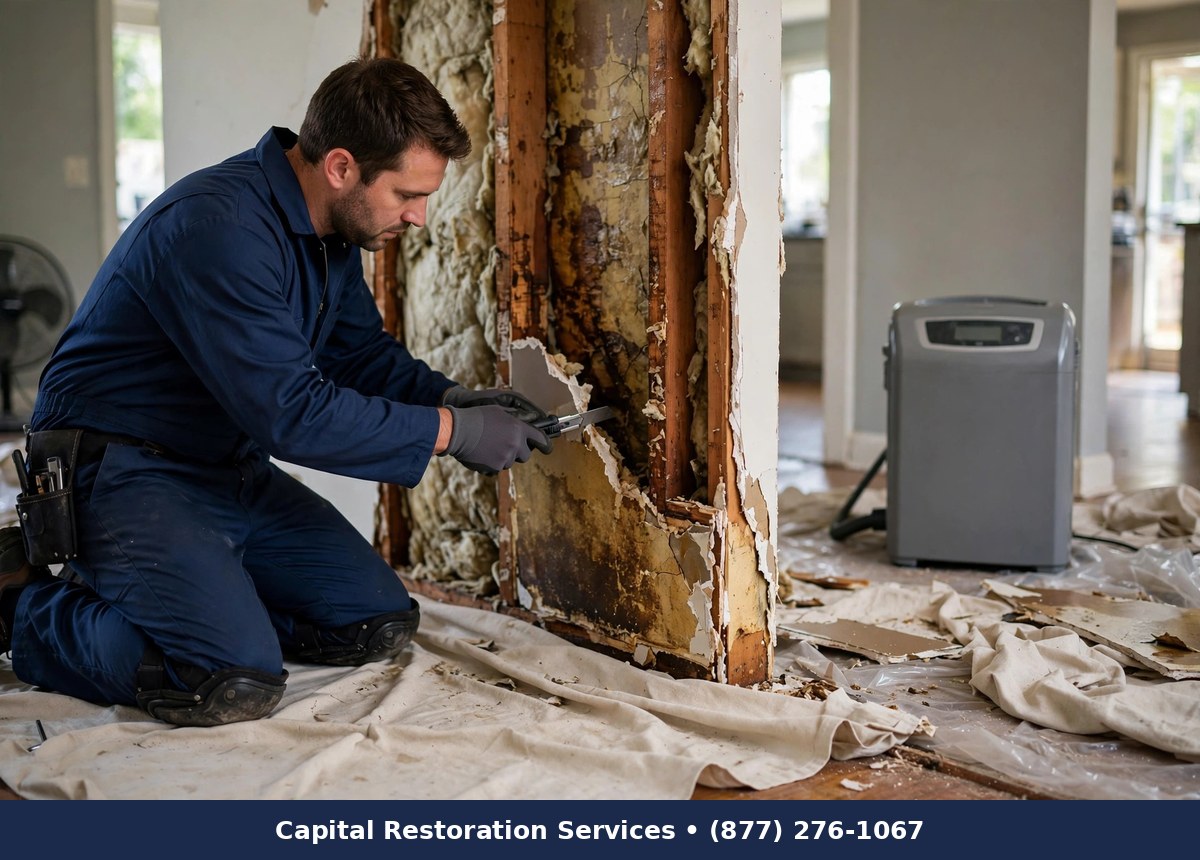
Drywall doesn't just get wet where the water touched it — it pulls water upward through capillary action, the same way a paper towel draws up a spill. A flood that reached six inches up the wall can leave moisture two feet high inside the drywall. That's why the visible water line lies to you, and why cutting out "just the stained part" misses the real damage. The paper facing on drywall is also mold's favorite food, which is why a wall that stays damp doesn't just look bad — it becomes a mold farm inside the cavity where you can't see it.
Plaster walls are a different animal — denser, slower to absorb, and repaired with different techniques. Knowing which wall type you're dealing with decides the whole approach, and it's the first thing we check.
Why painting over it always fails
It's the most tempting shortcut in home repair: the wall dried out (sort of), the stain is ugly, so you paint over it. Then the stain bleeds back through in a few weeks, or the paint bubbles, or a musty smell settles into the room. Here's why. Standard paint doesn't block water stains — the tannins and minerals in the stain migrate right through the new coat. Worse, if the wall is still damp inside, the paint traps that moisture and creates exactly the conditions mold needs. A painted-over wet wall is a sealed terrarium.
The fix isn't better paint — it's a dry wall first, then a stain-blocking primer, then paint. Skip any step and the stain comes back like it has a grudge.
How we decide what comes out
Not every wet wall needs demolition. Drywall that's merely damp from clean water — say, a supply line leak caught quickly — can often be dried in place with air movers and dehumidifiers, verified with meters. But drywall that's soft, swollen, crumbling, or sagging has lost its structure and will never be sound again, no matter how dry it gets. Drywall soaked by contaminated water (sewage, floodwater) comes out regardless — you don't dry and keep what floodwater touched.
When removal is needed, we do a flood cut: a clean horizontal cut a few inches above the highest moisture reading, so all the compromised material comes out in one clean section. This usually means removing the lower two to four feet of drywall, which conveniently matches standard sheet sizes for the replacement. Wet insulation comes out with it — fiberglass and cellulose that have been soaked don't dry back to useful, they just hold moisture against the framing.
Drying the cavity before rebuilding
With the damaged drywall out, the wall cavity gets its turn. Air movers push air into the open cavity, dehumidifiers pull the moisture out of the room air, and we take readings on the studs and remaining materials until they hit the dry standard. This step is where impatient repairs fail — closing up a wall that's still damp is how you get mold behind brand-new drywall six months later. We also treat the cavity if there's any microbial concern, so the new wall goes up over a clean, dry structure.
Then the rebuild: new drywall hung, seams taped and mudded, texture matched to the existing wall so the repair disappears. Stain-blocking primer goes over any remaining discoloration on the surviving upper wall, and the finish paint goes on last. Baseboards go back — new ones if the old ones wicked water and swelled. The wall should look like nothing ever happened, because structurally, nothing is still happening.
What affects the cost
How much wall got wet is the starting point, but height matters more than length — a flood cut at two feet is a different job than full-height replacement. The water type changes the scope: clean water that was caught fast can mean drying in place, while contaminated water means removal regardless. Whether insulation is involved adds labor and material, and plaster walls take more specialized work than drywall. Texture matching on the finish side — orange peel, knockdown, smooth — affects the refinishing time too. And as always, emergency response versus scheduled work plays its role. Call (877) 276-1067 and describe the wall; we'll tell you what it actually needs.
How Capital Restoration Services handles wall damage across the area
We've rebuilt walls after burst pipes, failed water heaters, storm flooding, and slow leaks that hid for months. Every one gets the same discipline: find how high the water really went, remove what's ruined, dry what's left, and finish it so the stain stays gone. If your wall is telling you something's wrong — the stain, the soft spot, the smell — call (877) 276-1067. We'll open it up, fix it right, and close it for good.
Features
- Moisture mapping that finds how high water wicked up the wall
- Strategic flood cuts that remove only the damaged lower section
- Wet insulation removal — soaked insulation never dries in place
- In-wall cavity drying with directed airflow and dehumidification
- Full drywall replacement with taping, mudding, and texture matching
- Texture-matched refinishing so the repair disappears into the existing wall
Benefits
- The wall is dry inside, not just repainted on the surface
- No hidden mold growing in the cavity behind fresh paint
- Repairs blend invisibly with the undamaged wall above
- Wet insulation gets replaced instead of left to fester
- Stain-blocking primer means the brown stain stays gone
- One crew handles demo, drying, and the finished wall
Frequently asked questions
Can water-damaged drywall be dried, or does it always need replacing?
It depends on condition, not just wetness. Drywall that's merely damp from clean water can often be dried in place and verified with meters. Drywall that's soft, swollen, sagging, or soaked with contaminated water has to be replaced. We test rather than assume.
Why did the water stain come back after I painted over it?
Two reasons, usually both: standard paint doesn't block stains — the discoloration migrates through the new coat — and if the wall was still damp inside, painting trapped the moisture. The lasting fix is a fully dry wall, then stain-blocking primer, then paint.
How high up the wall does water damage go?
Higher than the visible line. Drywall wicks water upward, so moisture often extends well above where you see staining. We map it with meters before cutting, so the flood cut goes above the true moisture line — not just the visible one.
Do you replace the insulation inside the wall?
If it's wet, yes. Soaked fiberglass, cellulose, or mineral wool doesn't dry back to useful — it holds moisture against the framing and feeds mold. We remove wet insulation with the damaged drywall and install fresh insulation before closing up.
What about plaster walls — are they repaired the same way?
No, and that's why the wall type check comes first. With plaster we look at whether it's still bonded to its lath and whether the water was clean — those two answers decide between careful in-place drying and full removal. Either way, the approach is different from drywall from the first step.
What does wall water damage repair cost?
It depends on how much wall is affected, how high the water wicked, whether it's drywall or plaster, the water type, and how much finishing the repair needs. A small dry-in-place job and a full flood-cut rebuild are very different scopes. Call (877) 276-1067 for a real assessment.