Water Damage Assessment and Inspection Near Me
Starting price: Call for pricing
Every good restoration starts with a thorough inspection — and every bad one starts with skipping it. A professional water damage assessment finds the source, maps how far the moisture traveled (including where you can't see it), classifies the water type, and gives you a documented scope of what needs to happen. Capital Restoration Services inspects with meters, infrared cameras, and experience, then hands you a clear written report. Not sure how bad it is? Call (877) 276-1067.
What a real assessment includes
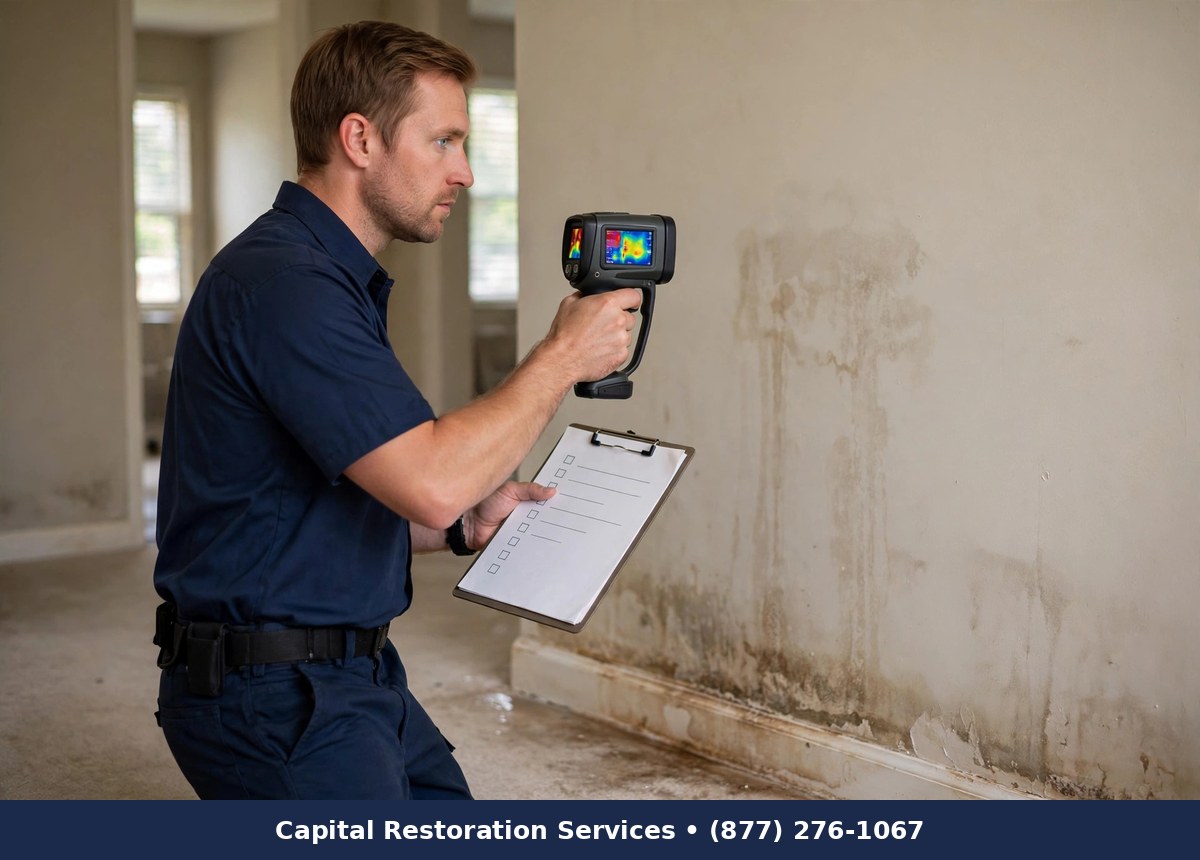
A proper water damage inspection is a methodical process, not a glance around the room. It starts with the story: when did you notice it, what's the suspected source, has it happened before? Then comes the visual survey — staining, swelling, buckling, discoloration — followed by the part that separates professionals from handymen: instrument readings. Infrared cameras scan walls and ceilings for the cool signatures of hidden moisture. Pinless meters sweep broad areas fast. Pin meters give exact moisture content at specific points. Together they build a moisture map: a room-by-room picture of what's wet, what's damp, and what's genuinely dry.
The assessment also classifies the water. Clean water from a supply line is handled differently than gray water from an appliance, which is handled very differently than black water from sewage or flooding. The category decides the safety protocols, what can be dried in place, and what must be removed. And the inspection covers the building systems too — is the water still coming in? Is there an electrical hazard? Has the structure been compromised? A good assessment answers all of this before a single piece of equipment is placed.
Why the inspection matters more than the equipment
Here's an uncomfortable truth about this industry: the drying equipment is largely the same from company to company. What separates a good restoration from a bad one is the assessment behind it. An incomplete inspection means missed moisture — the wet wall cavity nobody metered, the subfloor nobody lifted a vent to check, the insulation nobody thought about. Missed moisture becomes mold, odor, and a second round of demolition months later, usually after the insurance claim is closed.
A thorough assessment also protects you from the opposite problem: unnecessary demolition. Without meter readings, some companies tear out drywall "just in case." With readings, we know exactly which sections are wet and which are dry — and dry sections stay. The inspection is what makes the scope honest in both directions.
What to expect when we arrive
We start by listening — your account of what happened often points straight at the source. Then we suit up if needed (contaminated water means protective gear) and walk the property systematically, not just the room you called about. Water travels: a bathroom leak shows up in the ceiling below, a foundation leak appears three rooms over. We check adjacent spaces, the rooms below, and the areas above, because water follows gravity and pressure, not floor plans.
You'll see us photographing everything, metering walls and floors, and marking reference spots with tape. We may pull a floor vent, peek into a crawlspace access, or check the attic — wherever the moisture pattern leads. The whole visit usually takes under an hour for a typical residential loss. Before we leave, we'll tell you plainly what we found, what we recommend, and what it will take. The full written report with photos and readings follows.
How the findings become a scope of work
Raw findings aren't useful until they become a plan. The report translates readings into decisions: these materials can be dried in place, these must be removed, this is the equipment layout, this is the monitoring schedule. Each recommendation ties back to a specific reading or observation, so nothing in the scope is mysterious. You'll see why the drywall in the hallway is coming out but the bedroom wall is staying — because the meters said so.
This scope is also what your insurance adjuster works from. Adjusters don't approve vibes; they approve documented damage with readings, photos, and a line-item plan. A professional assessment report speaks their language, which is why claims backed by proper documentation move faster and with fewer disputes. ## When you need an assessment versus when you don't
Not every water incident needs a professional inspection. A spilled bucket on tile that you mopped up immediately? You're fine. But call for an assessment when water reached walls, got under flooring, came from an unknown source, sat for more than a day, involved anything other than clean water, or left any sign you can't fully explain — a stain with no obvious cause, a smell with no visible source, a floor that feels different. And sometimes the best outcome of an assessment is good news: it's dry, it's minor, here's what to watch for. We give that answer happily.
What affects the cost
Assessment pricing is simpler than restoration pricing: it scales with the size of the property and the complexity of the loss. A single-room leak is a shorter visit than a whole-house flood with multiple affected areas. Contaminated water adds safety protocols to the inspection. Commercial properties take longer than residential ones. In many cases, when we perform the restoration work, the assessment is folded into the project rather than billed separately. Call (877) 276-1067 and describe the situation — we'll tell you what the inspection involves for your specific case.
How Capital Restoration Services approaches every inspection
We treat the assessment as the most important hour of the whole job, because it is. No rushed walkthroughs, no predetermined conclusions, no scope written before the meters come out. Just a systematic inspection, honest findings, and a report you can actually use — whether you hire us for the restoration or not. If something's wrong with water in your building and you're not sure how wrong, call (877) 276-1067. Let's find out together.
Features
- Source identification — we find where the water came from, not just where it ended up
- Infrared thermal imaging to reveal hidden moisture behind walls and under floors
- Pin and pinless moisture meter readings documented by location
- Water category classification (clean, gray, or black water) per industry standard
- Written report with photos, readings, and a recommended scope of work
- Insurance-ready documentation formatted the way adjusters expect
Benefits
- You know the full extent of the damage before anyone starts tearing things out
- Hidden moisture gets found now, not discovered as mold six months later
- A documented scope prevents surprise costs mid-project
- Your insurance claim starts with professional evidence, not guesses
- The right drying plan gets built from real data, not assumptions
- An honest assessment tells you when you don't need major work, too
Frequently asked questions
What does a water damage assessment actually include?
A full inspection: finding the water source, visual survey of damage, infrared scanning for hidden moisture, meter readings documented by location, water category classification, and a written report with photos and a recommended scope of work. It's the blueprint everything else follows.
How long does an inspection take?
Usually under an hour for a typical residential loss. Larger properties or complex losses — multiple floors, contaminated water, hard-to-access areas — take longer. We don't rush it; the assessment is what keeps the rest of the job honest.
Do I need an inspection if I can see where the damage is?
Yes, because what you see is rarely all of it. Water wicks up drywall, travels under flooring, and hides in cavities. The inspection finds the moisture you can't see, which is exactly the moisture that causes problems later if it's missed.
Will the assessment help with my insurance claim?
That's one of its main jobs. The report documents damage with photos, readings, and a scope in the format adjusters expect. Claims backed by professional documentation move faster and face fewer disputes than claims based on descriptions alone.
What if the assessment finds nothing serious?
Then you get good news and peace of mind, which is a perfectly fine outcome. We'll tell you it's minor, explain what to watch for, and won't invent work that isn't there. An honest assessment sometimes means no restoration at all.
What does a water damage assessment cost?
It depends on the property size and the complexity of the loss — a single room versus a whole building, clean water versus contaminated. When we handle the restoration, the assessment is typically part of the project. Call (877) 276-1067 for the specifics of your situation.