
Water Heater Leak Damage Repair Near Me
Starting price: Call for pricing
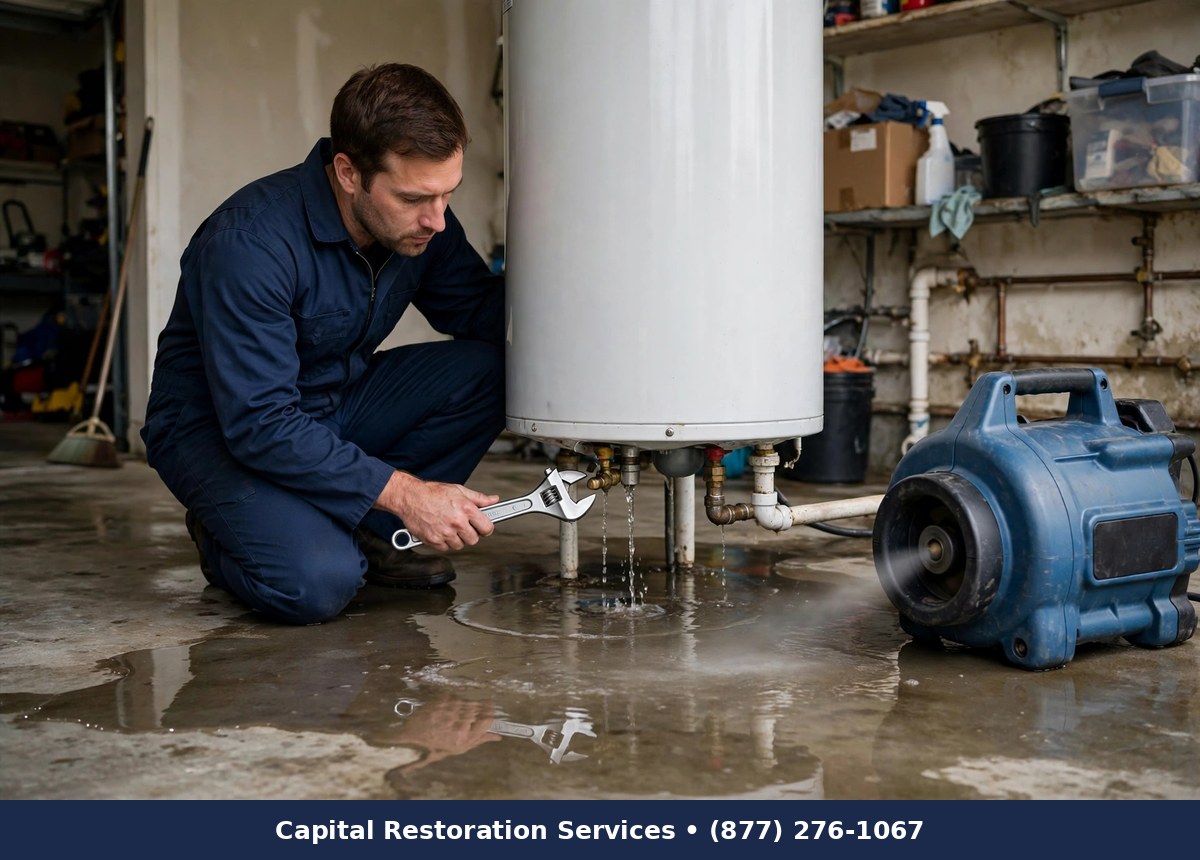
Your water heater holds forty or fifty gallons of water under pressure, and most of them sit in a closet or garage corner nobody inspects. When the tank rusts through or a fitting gives way, all of that water is suddenly your flooring's problem. Capital Restoration Services stops the leak, extracts the water, repairs the damaged floors and walls, and helps you figure out the heater's next step. Water around your heater? Call (877) 276-1067 now.
The appliance nobody looks at
Think about the last time you really looked at your water heater. For most homeowners, the answer is "when we moved in." It sits in a garage corner, a basement closet, or a utility room — out of sight, quietly holding dozens of gallons of pressurized hot water, year after year. And it's one of the most common sources of major residential water damage we see, precisely because it fails without an audience. A tank that rusts through at 2 a.m. doesn't announce itself. It just starts emptying.
Figuring out where the water is actually coming from
Not every puddle means a dead heater, and the distinction matters because it decides whether you're repairing or replacing. Water runs downhill, so a drip from a loose fitting at the top can pool at the base and look exactly like tank failure. The usual suspects, from cheapest to worst: loose inlet or outlet connections that need tightening, a worn drain valve at the bottom, the temperature-and-pressure relief valve discharging (which can mean high water pressure, a bad thermostat setting, or a failed valve — and should never be capped or plugged, since it's a critical safety device), and finally the tank itself rusting through. A rusted-through tank can't be repaired. That's a replacement, full stop.
We trace the leak to its real source before recommending anything — the paper-towel test along fittings, a look at the relief valve discharge, an assessment of the tank's age and condition. You deserve to know whether it's a fitting or a funeral.
What the water damages around a heater
Heaters live in unforgiving spots. In a garage, water spreads across concrete and into stored belongings, and wicks up the drywall at the base of the walls. In a basement, it finds the floor drain — or doesn't, and spreads. In a closet, it soaks the surrounding walls and the subfloor under them. Upstairs or attic installations are the worst case: water travels down through the ceiling, into wall cavities, and across floors below, multiplying the affected area.
We extract the standing water, then map the moisture: how far it spread through the flooring, how high it wicked up the walls, whether it reached adjacent rooms. Drying follows with dehumidifiers and air movers, verified by meter readings. Damaged drywall gets cut out and replaced, swollen baseboards get swapped, and flooring gets assessed honestly — some can be dried in place, some can't.
Repair the heater or replace it?
This is the question every water heater leak ends with, and the answer follows a few honest rules. A leaking fitting, drain valve, or relief valve on an otherwise healthy heater is a repair — straightforward and sensible. A tank that's rusted through is a replacement, no matter how new it seems, because tank corrosion doesn't reverse. Age is the tiebreaker: a heater past its expected lifespan (roughly a decade for most tank models) that's starting to leak is telling you it's done. Putting repair money into a tank that's already failing internally is throwing good money after bad.
The priority order is always the same: stop the water, dry the damage, then sort out the heater.
Making sure it doesn't happen again
The next heater should be harder to flood with. A drain pan under the unit, piped to a drain or the exterior, catches slow leaks before they reach the floor. A twenty-dollar leak alarm sitting in that pan screams the moment water appears — the cheapest early warning in your whole house. Know where the cold-water shutoff above the heater is, and make sure it actually turns; in an emergency, that's the valve that stops the flooding. And glance at the heater twice a year — rust at the base, moisture on the floor, a relief valve that's dripping. Two minutes, twice a year, beats a flooded garage.
What affects the cost
Two jobs are really happening: the water damage restoration and the heater itself. The restoration side depends on how much water escaped, how long it ran, where the heater sits (a garage floor is simpler than an upstairs closet), and what materials got wet. The heater side depends on whether it's a fitting repair or a full replacement, and what type of unit goes back in. Emergency timing factors in as well. What we won't do is blur the two together — you'll know what the drying and repair costs and what the heater costs, separately and clearly. Call (877) 276-1067 and let's sort out both.
How Capital Restoration Services handles heater leaks across the area
Water heater failures are some of our most frequent calls, and the playbook is well-worn: shut off the water, find the real source, extract, dry, repair the damage, and get you set up so the next heater can't do this again. If there's water around your heater right now, call (877) 276-1067. The sooner the water stops, the smaller this job stays.
Features
- Emergency water shutoff and leak source identification
- Water extraction from around and under the heater location
- Moisture mapping of floors, walls, and adjacent rooms
- Drying of subfloor, drywall, and framing to verified readings
- Repair or replacement coordination for the failed heater
- Drain pan, leak alarm, and shutoff upgrades to prevent a repeat
Benefits
- The water stops fast — we shut it down before more damage happens
- You learn whether it's a fitting fix or a full heater replacement
- Floors and walls dry properly instead of hiding moisture
- One call handles both the water damage and the heater question
- Prevention upgrades protect against the next failure
- Documentation that supports your insurance claim
Frequently asked questions
How do I know if my water heater is leaking or if it's just condensation?
Condensation happens on humid days or with a new unit and dries up on its own. A real leak persists and usually leaves rust staining, mineral deposits, or a consistently damp floor. If the wetness is still there a day later, or if you see rust anywhere on the tank, treat it as a leak.
What should I do first when I find water around my water heater?
Shut off the cold water supply valve above the heater — that stops the flooding. If it's a gas unit, turn the gas control to pilot or off; if electric, switch off the breaker. Then call (877) 276-1067. Don't touch the temperature-and-pressure relief valve to stop a drip — it's a safety device.
Can a leaking water heater be repaired, or must it be replaced?
Leaking fittings, drain valves, and relief valves can be repaired on a healthy tank. A tank that's rusted through cannot be repaired — that's a replacement. Age is the tiebreaker: a heater near the end of its expected life that's leaking is usually better replaced than patched.
Is a dripping temperature-and-pressure relief valve dangerous?
The drip itself isn't the danger — it's a symptom. The valve releases water when pressure or temperature gets too high, so a constant drip means something's wrong: excessive pressure, a bad thermostat, or a failed valve. Never cap or plug it. Get it checked promptly.
My water heater is in the attic. Is that a bigger problem?
Yes, when it leaks — gravity multiplies the damage as water travels down through ceilings and walls. Attic installations should always have a drain pan piped to the exterior plus a leak alarm. If yours doesn't, that's worth fixing before the leak, not after.
What does water heater leak damage repair cost?
There are two parts: the restoration (extraction, drying, floor and wall repair, driven by how much water escaped and where) and the heater itself (fitting repair versus full replacement). We price them separately and clearly. Call (877) 276-1067 and describe what you're seeing.