Whole-Home Mold Remediation Near Me
Starting price: Call for pricing
Sometimes mold isn't a spot — it's a system. When growth has spread through multiple rooms, colonized the HVAC, or hidden inside walls throughout the house, spot treatment just chases symptoms. Whole-home mold remediation follows the industry protocol: containment zones, negative air pressure, HEPA filtration, removal of what's unsalvageable, and verification that it's actually gone. Capital Restoration Services handles the full scope. Call (877) 276-1067.
When mold stops being a spot problem
Most mold jobs are local: a bathroom corner, a section of basement wall, the area under a leaky sink. Whole-home remediation is for when the problem has outgrown the spot. That happens a few ways. A major water event — flooding, a long-undiscovered leak, a burst pipe while you were away — can seed growth in wall cavities and under flooring across multiple rooms. Chronic high humidity can colonize attics, crawlspaces, and closets simultaneously. And once mold gets into the HVAC system, the ductwork becomes a distribution network, spreading spores to every room the air handler serves. At that point, treating one room is like bailing one corner of a sinking boat.
The other whole-home scenario is the invisible one: a persistent musty smell with no visible growth anywhere. That usually means hidden colonies — inside wall cavities, above ceilings, under flooring — spread widely enough to affect the whole house's air. Finding them takes a systematic inspection, not a glance.
Why the protocol matters at this scale
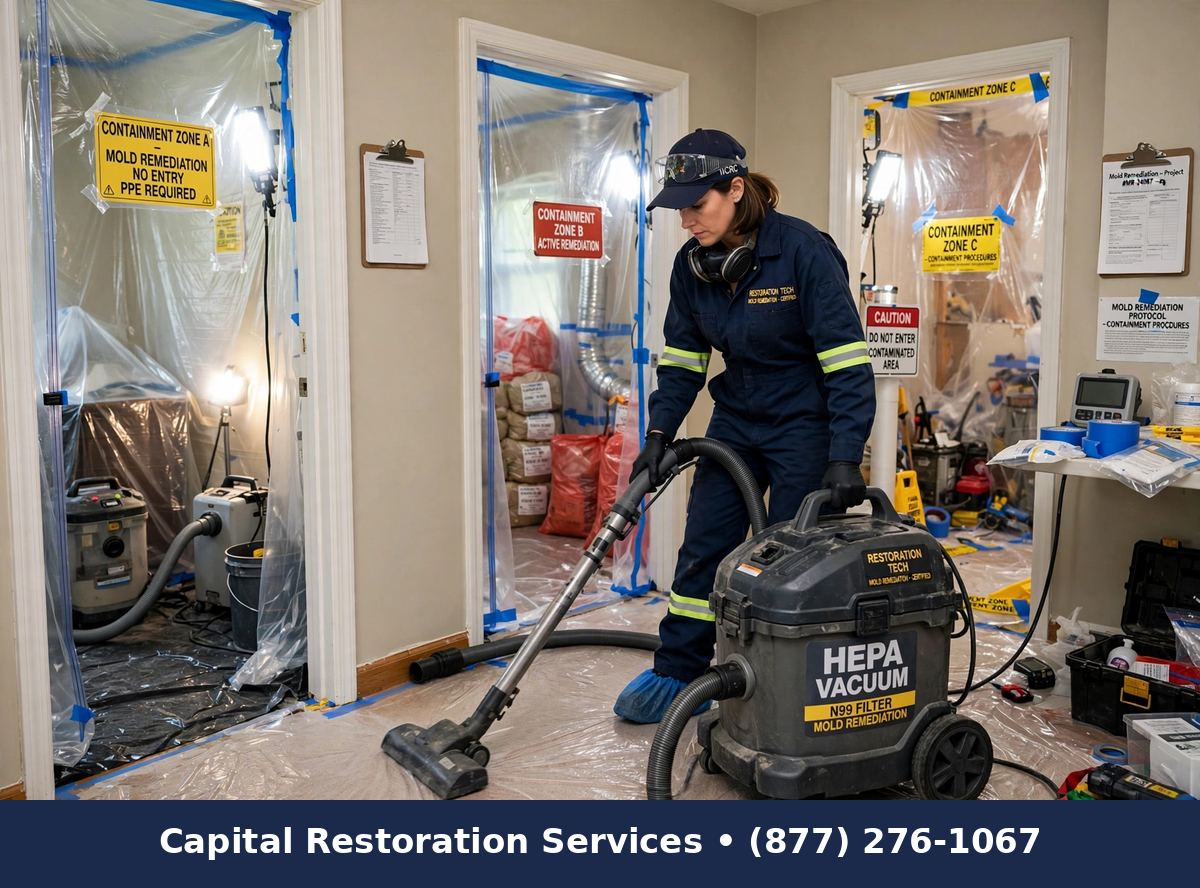
Small mold patches can be handled simply. Whole-home work can't, because the act of remediation itself — cutting out drywall, pulling insulation, disturbing colonies — releases enormous quantities of spores. Without proper controls, cleaning one area contaminates three more. That's why the industry standard (IICRC S520) exists, and why we follow it: containment barriers go up first, sealing work zones off from clean areas. Negative air machines exhaust filtered air outside the containment, so air always flows inward — spores can't ride air currents out into your living space. HEPA air scrubbers run continuously, capturing particles down to fractions of a micron.
This isn't theater. It's the difference between a remediation that solves the problem and one that spreads it. Any company that proposes tearing into moldy walls across your home without containment and negative air is creating a bigger problem than the one they were hired to fix.
What the process looks like, room by room
It starts with the full inspection: moisture mapping the entire property, thermal imaging for hidden wet areas, and identifying every colony — visible and suspected. Then the moisture source gets addressed. Remediation without fixing the leak, the drainage, the humidity, or the HVAC issue is just a reset button; the mold comes back. This step is non-negotiable and we won't skip it to save time.
Then containment goes up, zone by zone. Porous materials with deep growth — drywall, insulation, carpet pad — get removed, bagged in sealed plastic, and taken out through decontamination paths so they don't trail spores through clean areas. Semi-porous materials like framing and concrete get HEPA-vacuumed and cleaned; they can often be saved. Surviving structure gets antimicrobial treatment. The HVAC system gets addressed as its own scope — contaminated ductwork and components cleaned or replaced, because a remediated house with a dirty air handler will recontaminate itself the first time the system runs.
Finally, verification. We check visually, we check moisture readings, and we check air and surface samples against the agreed standard. The file closes when the data says it's closed — not when the calendar says so. You get documentation of all of it.
Living through a whole-home remediation
Let's be honest about the disruption: this is a significant project. Containment zones mean plastic barriers and equipment in your home for days to weeks depending on scope. Some areas will be off-limits during active work. For extensive jobs, many families choose to stay elsewhere during the heaviest removal phases — not because it's unsafe with proper containment, but because it's loud, dusty (inside the containment), and disruptive. We'll give you a realistic timeline and phasing plan upfront so you can decide. The goal is to make the disruption predictable, even if we can't make it invisible.
What affects the cost
Scope is everything here: how many areas are affected, how much material must be removed versus cleaned, whether the HVAC system is involved, and how long the moisture problem ran before discovery. Accessibility matters — attics and crawlspaces are slower work than open rooms. The verification standard you and your insurer agree on affects the testing scope. And the moisture-source repair (plumbing, roofing, drainage, dehumidification) is part of the total picture, because remediation without it is incomplete. This is genuinely a "we need to see it" situation — no honest company prices whole-home remediation blind. Call (877) 276-1067 and let's start with the inspection.
How Capital Restoration Services handles whole-home mold across the area
We've remediated homes after floods, long-term leaks, and humidity problems that touched every room — and the approach never changes: find it all, contain the work, remove what's unsalvageable, clean what can be saved, fix the moisture, and verify with data. If mold in your home feels bigger than a spot, call (877) 276-1067. We'll map the full extent and give you an honest scope.
Features
- Full-property mold inspection with moisture mapping and thermal imaging
- Containment zones with negative air pressure to protect clean areas
- HEPA air scrubbers running continuously during all removal work
- Removal of unsalvageable porous materials, bagged and sealed per protocol
- HEPA vacuuming and antimicrobial treatment of surviving structure
- Post-remediation verification: visual, moisture, and air/surface checks
Benefits
- The whole problem gets solved, not just the visible patches
- Containment keeps the rest of your home clean during the work
- HVAC and hidden cavities get addressed, not skipped
- Verification gives you documented proof the job is done
- The moisture source gets fixed so it doesn't come back
- Your home's air is genuinely clean when we're finished
Frequently asked questions
How do I know if I need whole-home remediation instead of spot treatment?
The signs are: growth in multiple rooms or areas, mold in the HVAC system, a persistent musty smell with no visible source, or a major water event that affected large areas. A systematic inspection with moisture mapping answers it definitively — we find every colony before recommending a scope.
Do we have to move out during whole-home mold remediation?
Not necessarily, but many families choose to during the heaviest removal phases. Proper containment and negative air keep clean areas safe, but the work is loud and disruptive. We'll phase the project and give you an honest recommendation based on the scope.
Will you test the air when you're done?
Verification is part of the protocol: visual inspection, moisture readings, and air or surface sampling against an agreed standard. The project closes when the data confirms it's done. You'll receive documentation of all of it for your records and your insurer.
What if the mold is in my air ducts?
Then the HVAC is part of the scope, not an afterthought. Contaminated ductwork redistributes spores every time the system runs, so a remediated house with dirty ducts will recontaminate itself. We address the ductwork and components as a coordinated part of the project.
Why can't you just clean the visible mold and be done?
Because visible growth is usually the smallest part of the problem. The colonies inside wall cavities, under flooring, and in the HVAC are what keep feeding spores into your air. Cleaning only what's visible leaves the system intact — and it all grows back.
What does whole-home mold remediation cost?
It depends entirely on scope: affected areas, material removal versus cleaning, HVAC involvement, and the moisture-source repair. No honest company prices this blind — it starts with a full inspection and a written scope. Call (877) 276-1067 to begin there.