Wildfire Smoke Damage Restoration Near Me
Starting price: Call for pricing
Your house didn't burn — but it breathed the fire. Wildfire smoke pushes ash and soot through attic vents, window gaps, and HVAC intakes, settling into insulation, ductwork, and every soft surface in the home. Capital Restoration Services restores wildfire-exposed homes top to bottom: attic to ducts to contents, with testing to prove what was cleaned. Smelling smoke after the fire passed? Call (877) 276-1067.
The house that didn't burn
Wildfire damage has a strange category: the standing home downwind. No flames touched it. Maybe there's no visible damage at all. But for days or weeks, smoke — carrying soot, char, ash, and a chemical load from everything the fire consumed — pressed against the house and found every gap. Attic vents, which are designed to breathe, inhaled it by the cubic foot. Window and door seals let it seep in. The HVAC system, if it was running, pulled it straight into the ductwork and distributed it to every room.
The result is a home that looks intact but smells like a campfire that won't go out — and the smell is the least of it. Fine ash settles into carpet fibers, upholstery, mattresses, and clothing. It coats the inside of ductwork. It blankets attic insulation, which acts as an enormous filter that then holds the contamination indefinitely. This is real damage, even without a scorch mark, and it deserves a real restoration — not just opening the windows for a weekend.
The attic: where wildfire smoke does its worst
If there's one place to check first, it's the attic. Wind-driven soot and ash get forced through attic vents and settle in piles on top of everything — insulation, ductwork, framing, stored belongings. Insulation is the big problem: fiberglass, cellulose, and rock wool trap smoke particles deep in their fibers, and they're nearly impossible to clean adequately. The standard recommendation after significant exposure is removal and replacement.
We inspect the attic thoroughly, document the contamination with photos, and remove affected insulation under controlled conditions so it doesn't rain down into your living space during removal. Exposed wood framing gets HEPA-vacuumed and treated, and ductwork in the attic gets assessed for cleaning or replacement. Skipping the attic is the most common reason wildfire odor "comes back" — because it was never gone, just sealed above the ceiling.
The HVAC system: the distribution network
Your heating and cooling system did exactly what it was designed to do during the fire: move air. Unfortunately, that air was full of smoke. Ash and soot coat the inside of ductwork, settle on the evaporator coil, clog filters, and infiltrate the air handler itself. Every time the system runs afterward, it redistributes a fresh dose of contamination — which is why the smell seems to pulse with the AC cycle.
We have the ductwork professionally cleaned to the industry standard, service or replace affected components, and install fresh high-efficiency filters. One critical note: don't run the system before it's been assessed. Running a contaminated HVAC spreads the problem deeper into the ductwork and onto the coil. If you must run it during the fire event for heat reasons, plan on a professional cleaning immediately after.
What the interior restoration involves
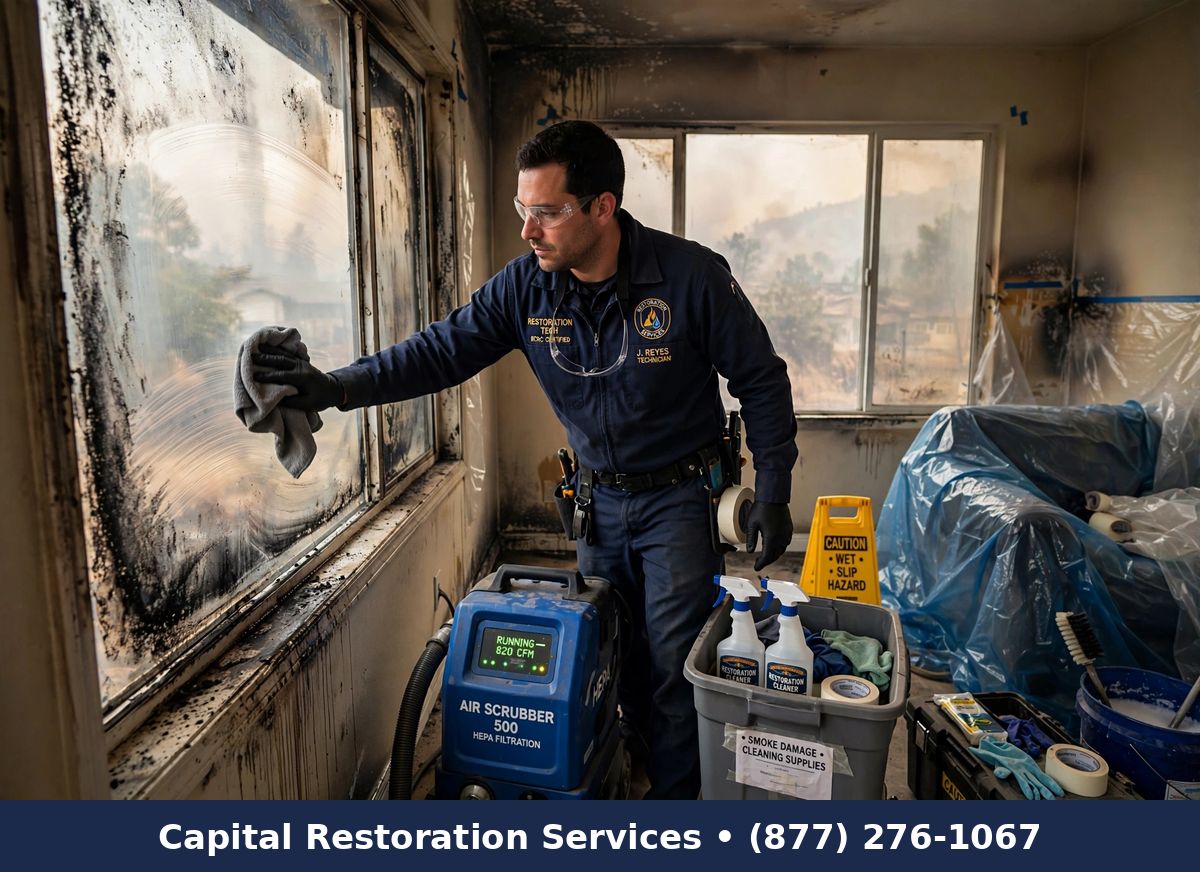
Inside the living space, the sequence matters. We start dry: HEPA vacuuming of all surfaces — walls, ceilings, floors, inside cabinets and closets — because wet-wiping ash before vacuuming just makes mud. Dry chemical sponges pull soot out of painted drywall without driving it deeper. Then targeted wet cleaning with the right chemistry for each surface, since wildfire ash is alkaline and needs appropriate detergents.
Soft goods get their own track: clothing, bedding, drapes, and upholstery go through professional textile cleaning and deodorization. Hard contents get wiped down individually. Throughout, air scrubbers with HEPA filtration run to capture what's airborne. Finally, deodorization — thermal fogging for deep penetration, hydroxyl generators for ongoing treatment — neutralizes the odor molecules that cleaning can't reach. The goal is a home that smells like nothing, verified by more than our noses.
Testing and the insurance question
Wildfire smoke claims are genuinely contested territory in insurance — the damage is real but often invisible, and carriers and homeowners don't always agree on the scope. That's why testing matters. Industrial hygienists can sample surfaces and air for combustion byproducts, and the results support the remediation scope with data instead of arguments. We document everything photographically, coordinate with testing professionals when the situation calls for it, and write our scope to follow the evidence. Whether your carrier is cooperative or difficult, a well-documented file is your strongest position. Keep every receipt and photograph from the moment you return.
What affects the cost
Exposure level is the main driver — a home a mile from the fire line with light ash is a different project than one that sat in heavy smoke for two weeks. Attic insulation replacement, which many wildfire jobs need, is a significant line item on its own. HVAC cleaning scope, the volume of contents needing professional cleaning, and whether testing is involved all add up. The honest path is an assessment first: we inspect the attic, the HVAC, and the living space, and scope from evidence. Call (877) 276-1067 and let's see what the fire left behind.
How Capital Restoration Services restores wildfire-exposed homes
We've worked the full arc of wildfire smoke jobs — from light ash dusting to homes where the attic insulation had to come out entirely. Attic to ducts to contents, cleaning before deodorizing, testing where it counts. If your home breathed the fire, call (877) 276-1067. Let's get it breathing clean again.
Features
- Attic inspection and smoke-exposed insulation assessment and replacement
- HVAC system and ductwork cleaning by qualified technicians
- HEPA vacuuming of all surfaces, including ceilings and inside cabinets
- Dry chemical sponge cleaning of walls before any wet methods
- Contents cleaning: textiles, upholstery, and household items
- Thermal fogging and hydroxyl deodorization for lingering smoke odor
Benefits
- The smoke smell leaves for good, not just for a week
- Your HVAC stops redistributing ash every time it runs
- Attic insulation that acted as a smoke filter gets replaced
- Testing documents the contamination and the cleanup for insurance
- Soft goods get professionally cleaned instead of thrown away
- Your home is genuinely safe to breathe in again
Frequently asked questions
My house didn't burn, but it smells like smoke. Is that really damage?
Yes. Wildfire smoke carries soot, ash, and chemical residues that infiltrate through vents, gaps, and HVAC systems, settling into insulation, ducts, and soft goods. It's invisible damage, but it's real — and it doesn't resolve with just airing out the house.
Should I run my AC after a wildfire?
Not before it's been checked. A contaminated HVAC system redistributes ash and soot every time it runs, driving contamination deeper. Replace the filter immediately, and have the ductwork professionally assessed and cleaned before running the system normally.
Does attic insulation need to be replaced after wildfire smoke exposure?
Often, yes. Insulation acts as a giant filter, trapping smoke particles deep where cleaning can't reach. After significant exposure, removal and replacement is the standard recommendation. We inspect and document the attic first so the decision is based on evidence.
Will my homeowner's insurance cover wildfire smoke damage?
It can, but these claims are frequently disputed because the damage is hard to see. Documentation is everything: photos, professional assessment, and testing results that prove the contamination. We build your file to withstand scrutiny from the start.
How long does wildfire smoke restoration take?
A light exposure — surface cleaning and HVAC service — can wrap up in days. Heavy exposure with attic insulation replacement, full contents cleaning, and deodorization takes weeks. We give you a realistic timeline after the assessment, not before.
What does wildfire smoke damage restoration cost?
It tracks the exposure: light ash cleanup versus attic insulation replacement, HVAC cleaning, contents restoration, and testing are very different scopes. An assessment of your attic, HVAC, and living space is the only honest starting point. Call (877) 276-1067.