Wood Framing Mold Treatment Near Me
Starting price: Call for pricing
When the drywall comes off after a leak, what's underneath is often a surprise: studs and joists wearing a coat of mold. The good news is that surface mold on framing usually hasn't weakened the wood — but it has to be properly removed, not just sprayed, before the wall closes back up. Capital Restoration Services cleans framing to the wood, treats it, verifies the structure is sound, and seals it against return. Found mold on your framing? Call (877) 276-1067.
Mold on wood is not the same as rot in wood
This distinction decides everything, so let's get it straight. Surface mold on framing feeds on the sugars and starches near the wood's surface. It looks alarming — black, green, fuzzy — but it doesn't eat the wood's structural fibers, which means it doesn't weaken the stud. Wood rot is a different organism doing a different job: rot fungi digest the structural polymers themselves, and rotted wood loses strength. A moldy stud is usually a cleaning job. A rotted stud is a replacement job.
Telling them apart takes more than a look. We probe the wood: sound lumber resists, giving only slightly under a sharp probe; rotted wood goes soft, spongy, or crumbly. We check moisture content, because active rot needs sustained wetness. And we look at how long the water ran — a leak caught in weeks usually means surface mold; a leak that ran for seasons can mean rot. This assessment happens before any treatment, because treating rotted wood as if it were merely moldy is how walls get closed up over failing structure.
Remove it, don't just kill it
Here's the principle that governs all proper framing treatment: the goal is removal, not killing. Dead mold is still allergenic — spores don't become harmless just because they're dead. Spraying a moldy stud with a killer and closing up the wall leaves the whole colony in place, corpses and all, still capable of causing problems and still visible as staining that worries every future home inspector.
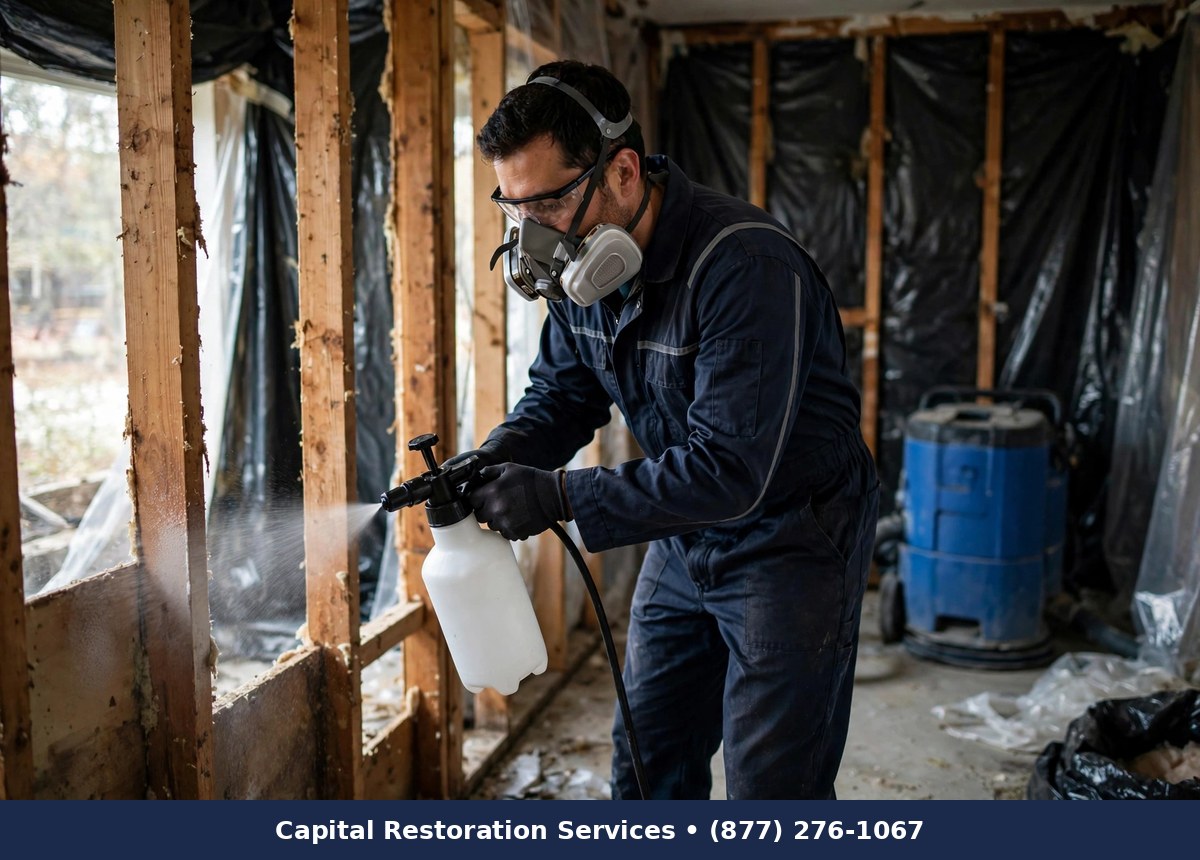
Real treatment is physical. For surface growth, that means HEPA-filtered sanding or wire brushing that takes the wood back to clean material, with the dust captured by HEPA filtration instead of spreading through the house. For heavier colonization on beams, joists, and sheathing, media blasting — dry ice or baking soda — strips growth from rough-sawn lumber and tight corners that sanding can't reach. After the physical removal, the wood gets antimicrobial treatment as a secondary step, not a substitute. The order matters: remove first, treat second, verify third.
When framing has to be replaced
Sometimes the honest answer is that a member can't be saved. Deep rot that has compromised the wood's strength, framing that's been wet so long it's lost density, or members where cleaning would remove too much material — these get replaced, not treated. Replacement is surgical: the damaged member comes out, a new one goes in, and connections are made properly. Sistering — adding a new member alongside a weakened one — is an option in some situations, but only where it's structurally appropriate, not as a shortcut around proper replacement.
We don't guess at this. If there's any question about load-bearing capacity, we say so plainly and recommend a structural engineer's evaluation before closing up. A wall is a terrible place to hide uncertainty.
The moisture source is the real job
Treating the framing without fixing the water is landscaping a swamp. Every framing mold job includes finding and addressing the moisture source: the roof leak, the plumbing drip, the failed flashing, the condensation problem, the grading issue sending water at the foundation. Sometimes we fix it as part of the job; sometimes it's a roofer's or plumber's work that we coordinate. Either way, the framing doesn't get sealed up until the water story is resolved. Mold needs sustained moisture to grow — take that away permanently and the treatment lasts.
Drying comes before treatment, too. Wood that's still wet gets dried to the proper moisture content first, because treating wet wood traps the moisture and the treatment doesn't take properly. Patience here is structural.
Sealing it up right
Once the framing is clean, dry, treated, and verified, it gets an encapsulating sealant before the wall closes. This isn't hiding anything — it's a protective coat over verified-clean wood that resists future moisture uptake and makes the framing less hospitable to any future growth. Then insulation goes back (fresh, never the old wet stuff), then drywall, then finish. The wall that closes is a fundamentally different wall than the one that opened: dry, clean, treated, sealed, and with its water problem solved.
What affects the cost
The extent of colonization is the main driver — a few studs in one wall versus framing throughout a basement or attic. The treatment method scales with severity: hand sanding and brushing for light growth, media blasting for heavy colonization. If members need replacement, carpentry adds to the scope. Accessibility matters — open framing in an unfinished basement is faster work than framing buried behind finishes that must be carefully opened. And the moisture-source repair is part of the honest total. Call (877) 276-1067 and let's look at your framing together.
How Capital Restoration Services treats framing across the area
We've cleaned framing after floods, long-term leaks, and humidity problems in attics and crawlspaces — and every job follows the same discipline: assess honestly, remove physically, treat properly, fix the water, verify, and seal. If you've opened a wall and found mold on the bones of your house, call (877) 276-1067. We'll tell you what's sound, fix what isn't, and close it up right.
Features
- Structural assessment: surface mold versus rot, tested not guessed
- HEPA-filtered sanding and wire brushing that removes growth to clean wood
- Dry ice and soda blasting for heavy colonization on beams and joists
- Antimicrobial treatment of cleaned framing per protocol
- Moisture source identification and repair so it can't come back
- Encapsulating sealant on treated framing before walls close up
Benefits
- Your framing is verified sound — or honestly flagged if it isn't
- Mold is physically removed, not just bleached over
- The wall closes up over clean, dry, treated wood
- No hidden colony waiting to bloom behind new drywall
- The moisture cause gets fixed, breaking the cycle
- Documentation of the framing condition for your records
Frequently asked questions
Is mold on wood framing dangerous to the structure?
Surface mold itself doesn't weaken wood — it feeds on surface compounds, not structural fibers. But the moisture that allowed the mold can cause rot, which does weaken wood. We probe and test the framing to determine which situation you're in before recommending treatment or replacement.
Can you just spray the mold on my studs and close up the wall?
No — and be wary of anyone who offers to. Dead mold is still allergenic, and spraying leaves the entire colony in place. Proper treatment physically removes the growth to clean wood, then applies antimicrobial treatment as a secondary step. Removal first, treatment second.
When does moldy framing need to be replaced instead of cleaned?
When the wood is rotted — soft, spongy, or crumbling — rather than just surface-moldy, or when cleaning would remove too much material to leave a sound member. We test with probing and moisture readings, and if load-bearing capacity is in question, we recommend a structural engineer's evaluation.
Will the mold come back after treatment?
Not if the moisture source is fixed, which is a required part of our process. Mold needs sustained moisture to grow. We identify and resolve the water issue — leak, drainage, condensation, whatever it is — before sealing up, and the encapsulant adds a further layer of protection.
How long does framing mold treatment take?
A few studs in an open wall can be treated in a day or two including drying verification. Larger areas with blasting, member replacement, and moisture-source repair take longer. Drying time is the part we won't rush — the wood has to be dry before treatment.
What does wood framing mold treatment cost?
It depends on how much framing is affected, whether it's surface mold or rot requiring replacement, the treatment method needed, and the moisture-source repair. An inspection of the exposed framing gives us what we need for an honest scope. Call (877) 276-1067.